




 Top
Top

Store of Value, Programmable Settlement, High-Speed Execution
Understanding how Bitcoin, Ethereum and Solana compare.
What are these three blockchains?
What are these three blockchains?
Bitcoin Fundamentals: Scarcity and Decentralization
Digital value transfer
What Is Bitcoin?
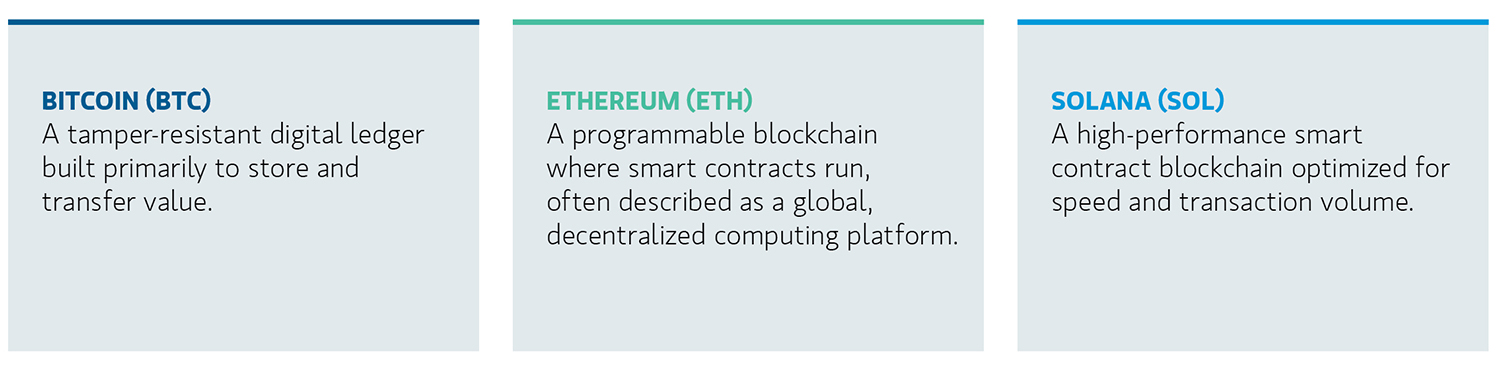
Bitcoin is a cryptocurrency designed to enable peer-to-peer transfers of value without relying on centralized intermediaries such as banks or governments. Introduced in 2009, it operates on its own blockchain—a shared network that records and verifies transactions.
How the Bitcoin Network Works
Bitcoin’s blockchain functions as a decentralized ledger that records transactions in chronological order. Transactions are grouped into “blocks,” validated by the network using proof-of-work and added to the blockchain at regular intervals.
Key Features
- Scarcity
Bitcoin has a fixed supply: The protocol limits total issuance to 21 million coins. New bitcoin is introduced at a predetermined pace that slows over time through block reward halving, supporting its positioning as a scarce digital asset often compared to gold. - Immutability/Decentralization
No single entity controls the network; once recorded, transactions generally cannot be altered without broad network consensus. - No Staking Yield
Because bitcoin uses proof-of-work, there is no staking or income component.
Common Use Cases
Store of value, inflation hedge, “digital gold,” sovereign reserves and peer-to-peer payments.
Who Holds It
Sovereign entities, corporate treasuries and individuals seeking a scarce, non-correlated asset.
Key Takeaway
Bitcoin’s decentralized structure and fixed supply distinguish it from traditional currencies and many other digital assets, reinforcing its positioning as a simple, durable monetary asset rather than a programmable platform.
Ethereum Fundamentals: Smart Contracts and Institutional-Grade Settlement
Programmable settlement, redefined
What Is Ethereum?
Ethereum is a smart contract blockchain that supports decentralized applications and digital assets through programmable code—enabling developers to build financial applications, marketplaces and tokenized assets on-chain.
How the Ethereum Network Works
Ethereum processes transactions and executes smart contracts across a distributed network of validators using proof-of-stake, where participants stake ETH to help secure the network and validate transactions in exchange for ETH rewards.
Key Features
- Programmability: Smart contracts allow developers to build decentralized finance (DeFi) applications, digital marketplaces and tokenized assets.
- Decentralization + security: No single entity controls the network; transactions are validated by a distributed set of participants (validators).
- Ecosystem depth: Ethereum supports one of the largest on‑chain ecosystems for DeFi, stablecoins, NFTs and tokenized assets.
- Adaptability: Ongoing network upgrades aim to improve scalability, efficiency and long‑term sustainability.
Common Use Cases
DeFi applications (including exchanges and lending), stablecoins, tokenized assets, NFTs/digital ownership and broader on‑chain financial activity.
Who Builds on It
Developers and institutions powering on‑chain financial infrastructure and applications.
Key Takeaway
Ethereum is a leading smart contract blockchain that supports decentralized financial applications, tokenization and on-chain innovation, with a programmable design and broad ecosystem that distinguish it from value-transfer-focused blockchains, like Bitcoin, and traditional financial systems.
Solana Fundamentals: Speed, Throughput and “Internet Capital Markets”
High-speed execution, at scale
What Is Solana?
Solana is a smart contract blockchain built to run applications and move on-chain assets at scale, with a focus on high speed and low costs.
How the Solana Network Works
Solana uses validators to verify transactions. It combines proof-of-stake with proof-of-history (a timing system) to help order transactions and process many at once—supporting high throughput and typically low fees. Validators can earn SOL rewards for helping run the network.
Key Features
- Scale: Designed to support high transaction volumes without relying on layer 2 blockchains.
- Speed: Transactions are confirmed quickly, enabling near real-time settlement for many applications.
- Low costs: Transaction fees are typically minimal, supporting micro transactions and high-volume use cases.
- Programmability: Smart contracts enable developers to create decentralized finance (DeFi) tools, digital marketplaces, gaming ecosystems and tokenized assets.
Common Use Cases
Solana is commonly associated with high‑frequency Decentralized Exchange (DEX) trading, consumer payments, token launches, gaming, mobile‑first applications, stablecoin settlement and prediction markets.
Who Builds on It
Developers and companies powering high-speed trading, payments and consumer applications.
Key Takeaway
Solana emphasizes execution speed and volume, aiming to support market-like activity and consumer applications where latency and fees matter.
Side-by-Side Summary: The Differences That Matter
Comparison framework
Primary role
Primary role
Staking/yield1

Staking/yield1
Speed Network

Speed Network
Three Blockchains, Three ETPs: How Investors Can Access the Framework
Crypto exchange-traded products (ETPs) provide native cryptocurrency exposure to the Bitcoin, Ethereum and Solana networks through traditional brokerage accounts, without requiring investors to hold digital assets directly. By tracking the underlying assets, these products can support different types of exposure depending on portfolio objectives.
Overall Key Takeaway
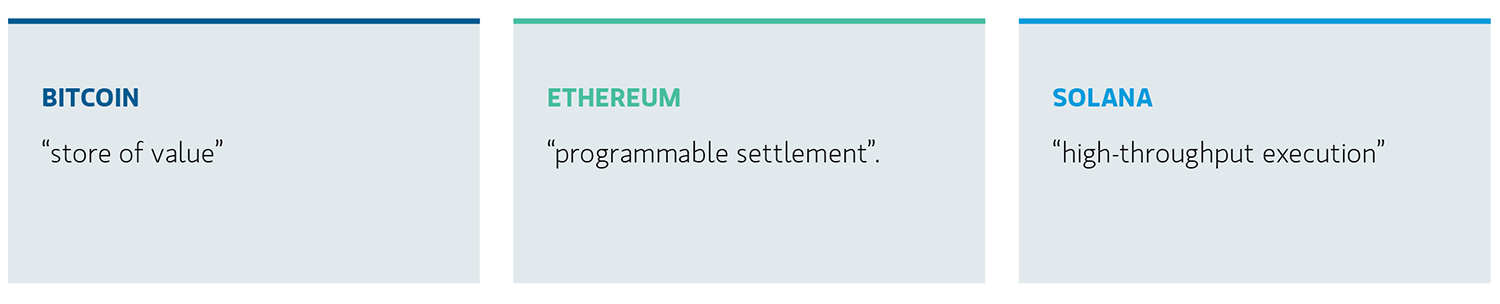
Bitcoin, Ethereum and Solana are often discussed together but serve different purposes: Bitcoin prioritizes scarcity and monetary resilience, Ethereum prioritizes secure programmable settlement, and Solana prioritizes high-speed execution for trading and consumer-scale activity.
ne 4, 2026
Featured Insights





IMPORTANT INFORMATION:
RISK CONSIDERATIONS
Spot Crypto ETPs are exchange-based products that track the price of an asset, i.e., bitcoin, by holding the actual asset as the underlying asset.
Blockchain is a shared, immutable ledger that facilitates the process of recording transactions and tracking assets in a business network.
Cryptocurrency (notably, Bitcoin) operates as a decentralized, peer-to-peer financial exchange and value storage that is used like money. It is not backed by any government. Federal, state or foreign governments may restrict the use and exchange of cryptocurrency. Cryptocurrency may experience very high volatility.
IMPORTANT DISCLOSURES:
The views and opinions and/or analysis expressed are those of the author or the investment team as of the date of preparation of this material and are subject to change at any time without notice due to market or economic conditions and may not necessarily come to pass. Furthermore, the views will not be updated or otherwise revised to reflect information that subsequently becomes available or circumstances existing, or changes occurring, after the date of publication. The views expressed do not reflect the opinions of all investment personnel at Morgan Stanley Investment Management (MSIM) and its subsidiaries and affiliates (collectively the Firm”) or the views of the firm as a whole, and may not be reflected in all the strategies and products that the Firm offers.
Forecasts and/or estimates provided herein are subject to change and may not actually come to pass. Information regarding expected market returns and market outlooks is based on the research, analysis and opinions of the authors or investment team. These conclusions are speculative in nature, may not come to pass and are not intended to predict the future performance of any specific strategy or product the Firm offers. Future results may differ significantly depending on factors such as changes in securities or financial markets or general economic conditions.
This material has been prepared on the basis of publicly available information, internally developed data and other third-party sources believed to be reliable. However, no assurances are provided regarding the reliability of such information and the Firm has not sought to independently verify information taken from public and third-party sources.
This material is a general communication, which is not impartial and all information provided has been prepared solely for informational and educational purposes and does not constitute an offer or a recommendation to buy or sell any particular security or to adopt any specific investment strategy. The information herein has not been based on a consideration of any individual investor circumstances and is not investment advice, nor should it be construed in any way as tax, accounting, legal or regulatory advice. To that end, investors should seek independent legal and financial advice, including advice as to tax consequences, before making any investment decision.
The Firm does not provide tax advice. The tax information contained herein is general and is not exhaustive by nature. It was not intended or written to be used, and it cannot be used by any taxpayer, for the purpose of avoiding penalties that may be imposed on the taxpayer. Each Jurisdiction tax laws are complex and constantly changing. You should always consult your own legal or tax professional for information concerning your individual situation.
Charts and graphs provided herein are for illustrative purposes only. Past performance is no guarantee of future results.
This material is not a product of Morgan Stanley’s Research Department and should not be regarded as a research material or a recommendation.
The Firm does not provide tax advice. The tax information contained herein is general and is not exhaustive by nature. It was not intended or written to be used, and it cannot be used by any taxpayer, for the purpose of avoiding penalties that may be imposed on the taxpayer under U.S. federal tax laws. Federal and state tax laws are complex and constantly changing. You should always consult your own legal or tax professional for information concerning your individual situation.
The whole or any part of this material may not be directly or indirectly reproduced, copied, modified, used to create a derivative work, performed, displayed, published, posted, licensed, framed, distributed or transmitted or any of its contents disclosed to third parties without MSIM’s express written consent. This material may not be linked to unless such hyperlink is for personal and non-commercial use. All information contained herein is proprietary and is protected under copyright and other applicable law.
Investing in digital assets involves risk, including possible loss of principal. An investment in Morgan Stanley Bitcoin Trust (MSBT), Morgan Stanley Ethereum Trust (MSSE) and/or Morgan Stanley Solana Trust (MSOL) (each, a “Trust” and collectively, the “Trusts”) are subject to a high degree of risk and heightened volatility. Each Trust is not suitable for any investor that cannot afford loss of the entire investment.
Each Trust has filed a registration statement (including a prospectus) with the U.S. Securities and Exchange Commission (the “SEC”) for the offerings to which this communication relates. Before you invest, you should read the relevant prospectus and other documents such Trust has filed with the SEC for more complete information about such Trust and the related offering.
Morgan Stanley Investment Management Inc. is the Delegated Sponsor and Foreside Fund Services, LLC is the Marketing Agent for each Trust.
This information must be preceded or accompanied by a prospectus, click here (MSBT; MSSE; MSOL[LM1] ) to view or download the prospectus, for each Trust. You should consider a Trust’s objectives, risks, charges and expenses carefully before investing. Each Trust’s prospectus contains this and other important information about such Trust. Please read a Trust’s prospectus carefully before you invest.
These Trusts are not registered under the Investment Company Act of 1940, as amended (the “40 Act”), and are not subject to regulation under the 40 Act, unlike most mutual funds or ETFs. Each Trust may trade at a premium or discount to its net asset value. Each Trust is new and has a limited operating history upon which investors may base an evaluation of its likely performance.
The value of each Trust relates directly to the value of the underlying digital asset such Trust holds, the value of which are highly volatile and subject to fluctuations due to a number of factors.
Each Trust relies on third party service providers to perform certain functions essential to the affairs of such Trust. Some of these service providers may not be subject to federal regulation and oversight and the replacement of such service providers could pose a challenge to the safekeeping of the digital asset and to the operations of each Trust.
No guarantee or representation is made that any Trust’s investment strategy, including, without limitation, their investment objectives or strategies, will be successful, and investment results may vary substantially over time. Nothing herein is intended to imply that any Trust’s investment methodology or that investing may be considered “conservative,” “safe,” “risk free,” or “risk averse.”
This material is not an offer or solicitation of any kind to buy or sell any securities outside of the United States of America. Nothing in this content should be considered a solicitation to buy or an offer to sell shares of any investment in any jurisdiction where the offer or solicitation would be unlawful under the securities laws of such jurisdiction, nor is it intended as investment, tax, financial, or legal advice. Investors should seek such professional advice for their particular situation and jurisdiction.
Digital Asset Risk Disclosures
Many digital assets, including bitcoin, SOL and ether, have experienced significant volatility in trading prices in recent periods and may continue to experience volatility in the future. Such volatility in digital asset prices could have a material adverse effect on the value of such Trust and its shares could lose all or substantially all of their value.
Digital assets represent a new and rapidly evolving industry. The value of each Trust depends, among other things, on the acceptance of the digital assets in general and bitcoin, ether or SOL in particular, the capabilities and development of blockchain technologies and the fundamental investment characteristics of bitcoin, ether or SOL, as applicable.
Digital asset networks are developed and maintained by a diverse set of contributors and the perception that certain contributors will no longer contribute to a network or may decrease their contributions to, or involvement with such network could have an adverse effect on the market price of the related digital asset.
Digital assets may have concentrated ownership and large sales or distributions by holders of digital assets could have an adverse effect on the market price of such digital asset.
As discussed in the relevant prospectus, MSSE and MSOL each expect to stake certain of their assets in accordance with their respective staking and liquidity policy and, therefore, may receive staking rewards. Staking rewards can vary significantly over time. Staking activity comes with a risk of loss including, depending on the mechanics of a relevant blockchain, “slashing” penalties, which may be assessed if third party validators contracted to engage in staking activities on behalf of a Trust engage in misbehavior or perform poorly. There is no guarantee a Trust will recover any of its staked assets, or the value thereof, if they become subject to slashing penalties. In addition, activation and exit buffer periods may limit when assets become eligible to accrue staking rewards, when they may be unstaked, withdrawn and ultimately sold by the Trust in connection with redemption and creation orders and to pay for expenses. The length of these periods are monitored and considered as part of each Trust’s staking and liquidity policy, pursuant to which MSSE and MSOL expect to stake less than all of their respective digital assets which reduces the potential amount of staking rewards receivable by each Trust and by extension the value of their respective shares.
Staking introduces the risk of loss staked digital assets, which could adversely affect the value of a Trust’s shares if any such losses occur. Staking often includes activation, exit, and withdrawal periods, during which staked digital assets cannot be sold or transferred and are therefore illiquid. The Ethereum and Solana protocols limit validator activations and exits per epoch, so only a controlled amount of staked ether or SOL can turnover each epoch (in the case of the Ethereum protocol, the activation period may extend for days, weeks, or months depending on the demand queue). While queued for activation, while unbonding and during withdrawal periods, staked digital assets are generally not eligible to accrue staking rewards. At each step in the staking process, staked digital assets may be exposed to risks such as security breaches, smart contract vulnerabilities, and validator or custodian failure or compromise, any of which could result in a complete loss of the staked digital asset in question or associated staking rewards. There is no guarantee that a Trust will receive any staking rewards.
Neither MSBT, MSSE nor MSOL provide investors with direct exposure to spot bitcoin, ether or SOL, respectively, and investments in the Trusts are not a direct investment in bitcoin, ether or SOL. As non-diversified and single industry funds, the value of each Trust’s shares may fluctuate more than shares invested in a broader range of industries. Because the value of each Trust is correlated with the value of bitcoin, ether and SOL, respectively, it is important to understand the investment attributes of, and the market for, the underlying digital assets. Please consult with your financial professional.
A substantial direct investment in a digital asset may require expensive and sometimes complicated arrangements in connection with the acquisition, security and safekeeping of the digital asset and may involve the payment of substantial fees to third party service providers through cash payments of U.S. dollars.
Regulation of digital assets, including bitcoin, ether and SOL, continues to evolve across different jurisdictions worldwide, which may cause uncertainty and insecurity as to the legal and tax status of a given digital asset. As bitcoin, ether, SOL and other digital assets have grown in both popularity and market size, the U.S. Congress and a number of U.S. federal and state agencies have been examining the operations of digital asset networks, digital asset users and the digital asset spot market. Many of these state and federal agencies have brought enforcement actions and issued advisories and rules relating to digital asset markets. Ongoing and future regulatory actions with respect to digital assets generally or any single digital asset in particular may alter, perhaps to a materially adverse extent, the nature of an investment in a Trust.
The Delegated Sponsor does not store, hold, or maintain custody or control of any Trust’s digital assets, but instead has entered into Custodial Services Agreements with third parties to facilitate the security of its bitcoin, ether or SOL, respectively. The custodians control and secure the Trusts’ bitcoin, ether or SOL, in segregated custody accounts to store private keys, which allows for the transfer of ownership or control of the Trusts’ bitcoin, ether or SOL, on the respective Trust’s behalf. If a custodian resigns or is removed by the Delegated Sponsor or otherwise, without replacement, it could trigger early termination of a Trust.
COINDESK® and the name(s) of the CoinDesk index or indices referenced herein, including the CoinDesk 20 Index (“CDI Indices”) are trade or service marks of CoinDesk Indices, Inc. (with CC Data Limited, its affiliate which performs certain outsourced administration services on its behalf, “CDI”), and/or its licensors. CDI or CDI's licensors own all proprietary rights in CDI Indices. CDI is not the issuer, sponsor or producer of any financial product, derivative, portfolio, bundle, basket, separately managed account, or any other investment exposure that tracks, seeks to track, references, or settles against CDI Indices (collectively, “Products”) and CDI has no responsibilities, obligations, or duties to investors in or holders of Products. CDI Indices are licensed for use by the financial services provider named herein (“Provider”). CDI does not approve, endorse, review, or recommend any Product. CDI does not guarantee the timeliness, accurateness, or completeness of any data or information relating to CDI Indices and shall not be liable in any way to investors in or holders of any Product or other third parties in respect of the use or accuracy, completeness, or timeliness of any CDI Indices or any data included therein. CoinDesk Indices 2026.
Before making an investment decision in a Trust, you should carefully consider the risk factors and other information included such Trust’s prospectus.
Investors should be aware that investing in MSBT, MSSE and MSOL is not equivalent to investing directly in bitcoin, ether or SOL, as applicable.
Forward-Looking Statements
Certain statements contained herein and in any related materials may constitute forward-looking statements within the meaning of Section 27A of the Securities Act of 1933, as amended, and Section 21E of the Securities Exchange Act of 1934, as amended. Forward-looking statements can generally be identified by the use of words such as "anticipate," "believe," "continue," "could," "estimate," "expect," "intend," "may," "might," "plan," "potential," "predict," "project," "seek," "should," "target," "will," "would," or similar expressions, or the negative of such terms. These statements are based on current expectations, estimates, assumptions, and projections and are subject to significant risks, uncertainties, and other factors that may cause actual results, performance, or developments to differ materially from those expressed or implied by such statements. Forward-looking statements speak only as of the date on which they are made. Each Trust undertakes no obligation to update or revise any forward-looking statement, whether as a result of new information, future events, or otherwise, except to the extent required by applicable law.
DISTRIBUTION
This material is only intended for and will only be distributed to persons resident in jurisdictions where such distribution or availability would not be contrary to local laws or regulations.
MSIM, the asset management division of Morgan Stanley (NYSE: MS), and its affiliates have arrangements in place to market each other’s products and services. Each MSIM affiliate is regulated as appropriate in the jurisdiction it operates. MSIM’s affiliates are: Calvert Research and Management, Eaton Vance Management, Parametric Portfolio Associates LLC, Parametric SAS, and Atlanta Capital Management LLC.
This material has been issued by any one or more of the following entities:
EMEA
This material is for Professional Clients/Accredited Investors only.
In the EU, MSIM materials are issued by MSIM Fund Management (Ireland) Limited (“FMIL”). FMIL is regulated by the Central Bank of Ireland and is incorporated in Ireland as a private company limited by shares with company registration number 616661 and has its registered address at 24-26 City Quay, Dublin 2, DO2 NY19, Ireland.
Outside the EU, MSIM materials are issued by Morgan Stanley Investment Management Limited (MSIM Ltd) is authorized and regulated by the Financial Conduct Authority. Registered in England. Registered No. 1981121. Registered Office: 25 Cabot Square, Canary Wharf, London E14 4QA.
In Switzerland, MSIM materials are issued by Morgan Stanley & Co. International plc, London (Zurich Branch) Authorised and regulated by the Eidgenössische Finanzmarktaufsicht ("FINMA"). Registered Office: Beethovenstrasse 33, 8002 Zurich, Switzerland.
Italy: MSIM FMIL (Milan Branch), (Sede Secondaria di Milano) Palazzo Serbelloni Corso Venezia, 16 20121 Milano, Italy. The Netherlands: MSIM FMIL (Amsterdam Branch), Rembrandt Tower, 11th Floor Amstelplein 1 1096HA, Netherlands. France: MSIM FMIL (Paris Branch), 61 rue de Monceau 75008 Paris, France. Spain: MSIM FMIL (Madrid Branch), Calle Serrano 55, 28006, Madrid, Spain. Germany: MSIM FMIL Frankfurt Branch, Große Gallusstraße 18, 60312 Frankfurt am Main, Germany (Gattung: Zweigniederlassung (FDI) gem. § 53b KWG). Denmark: MSIM FMIL (Copenhagen Branch), Gorrissen Federspiel, Axel Towers, Axeltorv2, 1609 Copenhagen V, Denmark.
MIDDLE EAST
Dubai International Financial Centre: This information does not constitute or form part of any offer to issue or sell, or any solicitation of any offer to subscribe for or purchase, any securities or investment products in the UAE (including the Dubai International Financial Centre and the Abu Dhabi Global Market) and accordingly should not be construed as such. Furthermore, this information is being made available on the basis that the recipient acknowledges and understands that the entities and securities to which it may relate have not been approved, licensed by or registered with the UAE Central Bank, the Dubai Financial Services Authority, the UAE Securities and Commodities Authority, the Financial Services Regulatory Authority or any other relevant licensing authority or government agency in the UAE. The content of this report has not been approved by or filed with the UAE Central Bank, the Dubai Financial Services Authority, the UAE Securities and Commodities Authority or the Financial Services Regulatory Authority.
Abu Dhabi Global Market ("ADGM"): This material is sent strictly within the context of, and constitutes, an Exempt Communication. This material relates to Digital Assets which is not subject to any form of regulation or approval by the Financial Services Regulatory Authority of the Abu Dhabi Global Market (the “FSRA”).
Saudi Arabia
This financial promotion was issued and approved for use in Saudi Arabia by Morgan Stanley Saudi Arabia, Al Rashid Tower, Kings Sand Street, Riyadh, Saudi Arabia, authorized and regulated by the Capital Market Authority license number 06044-37.
U.S.
NOT FDIC INSURED | OFFER NO BANK GUARANTEE | MAY LOSE VALUE | NOT INSURED BY ANY FEDERAL GOVERNMENT AGENCY | NOT A DEPOSIT
Latin America (Brazil, Chile Colombia, Mexico, Peru, and Uruguay)
This material is for use with an institutional investor or a qualified investor only. All information contained herein is confidential and is for the exclusive use and review of the intended addressee and may not be passed on to any third party. This material is provided for informational purposes only and does not constitute a public offering, solicitation or recommendation to buy or sell for any product, service, security and/or strategy. A decision to invest should only be made after reading the strategy documentation and conducting in-depth and independent due diligence.
ASIA PACIFIC
Hong Kong: This document has been issued by Morgan Stanley Asia Limited, CE No. AAD291, for use in Hong Kong and shall only be made available to “professional investors” as defined under the Securities and Futures Ordinance of Hong Kong (Cap 571). The contents of this document have not been reviewed nor approved by any regulatory authority including the Securities and Futures Commission in Hong Kong. Accordingly, save where an exemption is available under the relevant law, this document shall not be issued, circulated, distributed, directed at, or made available to, the public in Hong Kong. Singapore: This material is disseminated in Singapore by Morgan Stanley Investment Management Company, Registration No. 199002743C. This material should not be considered to be the subject of an invitation for subscription or purchase, whether directly or indirectly, to the public or any member of the public in Singapore other than (i) to an institutional investor under section 304 of the Securities and Futures Act, Chapter 289 of Singapore (“SFA”), (ii) to a “relevant person” (which includes an accredited investor) pursuant to section 305 of the SFA, and such distribution is in accordance with the conditions specified in section 305 of the SFA; or (iii) otherwise pursuant to, and in accordance with the conditions of, any other applicable provision of the SFA. This material has not been reviewed by the Monetary Authority of Singapore. Australia: This material is provided by Morgan Stanley Investment Management (Australia) Pty Ltd ABN 22122040037, AFSL No. 314182 and its affiliates and does not constitute an offer of interests. Morgan Stanley Investment Management (Australia) Pty Limited arranges for MSIM affiliates to provide financial services to Australian wholesale clients. This material will not be lodged with the Australian Securities and Investments Commission.
Japan
For professional investors, this material is circulated or distributed solely for informational purposes. For non-professional investors, this material is provided in connection with Morgan Stanley Investment Management (Japan) Co., Ltd. (“MSIMJ”)’s business with respect to discretionary investment management agreements (“IMA”) and investment advisory agreements (“IAA”). This does not constitute a recommendation or solicitation of transactions nor offers any particular financial instruments. Under an IMA, with respect to the management of client assets, the client prescribes basic management policies in advance and commissions MSIMJ to make all investment decisions based on an analysis of the value, etc. of the securities, and MSIMJ accepts such commission. The client shall delegate to MSIMJ the authorities necessary to make such investment decisions. MSIMJ exercises these delegated authorities accordingly, and the client shall not make individual instructions. All investment profits and losses belong to the clients; principal is not guaranteed. Please consider the investment objectives and nature of risks before investing. As an investment advisory fee for an IAA or an IMA, the amount of assets subject to the contract multiplied by a certain rate (the upper limit is 2.20% per annum (including tax)) shall be incurred in proportion to the contract period. For some strategies, a contingency fee may be incurred in addition to the fee mentioned above. Indirect charges also may be incurred, such as brokerage commissions for underlying securities. Since these charges and expenses vary by contract and other factors, MSIMJ cannot present the rates, upper limits, etc. in advance. All clients should read thoroughly the Documents Provided Prior to the Conclusion of a Contract carefully before executing an agreement. This material is distributed in Japan by MSIMJ, Registered No. 410 (Director of Kanto Local Finance Bureau (Financial Instruments Firms)), Membership: the Japan Securities Dealers Association, the Investment Management Association of Japan and the Type II Financial Instruments Firms Association.


 This image indicates content designed specifically for Financial Advisors / Investment Professionals. This material is not to be used with the public.