




 Top
Top

Monthly Review
June was characterized by a growing acceptance of a "higher-for-longer" macro environment as resilient economic data, persistent inflation, and cautious central bank messaging reinforced expectations that policy rates may remain restrictive for longer than previously anticipated. Despite this shift, fixed income markets remained remarkably resilient. Lower rates volatility, strong technical demand, and continued investor appetite for carry supported spread sectors even as issuance reached record levels across several markets.
Rates markets reflected this backdrop of resilient growth and cautious central banks. U.S. Treasury yields moved modestly higher, with the 10-year Treasury ending the month at 4.47%, while front-end yields rose more materially as markets continued to price a higher-for-longer policy path. Elsewhere, yields generally declined across Europe and other developed markets, reflecting weaker growth dynamics outside the U.S. Market-implied inflation expectations eased modestly during the month, with U.S. 10-year breakevens declining, though inflation remained the dominant macro theme. The U.S. dollar strengthened, rising approximately 2.3% against a broad basket of currencies.
Credit markets remained remarkably resilient despite historically tight valuations. U.S. investment grade spreads widened modestly by 2 basis points (bps) to 74bps, while Euro investment grade widened 1bp to 80bps, reflecting stable rather than deteriorating risk sentiment despite record issuance. Demand for all-in yield remained exceptionally strong, allowing both U.S. and European markets to absorb elevated primary supply with only limited concessions. A notable feature of the month was the continued acceleration in AI-related financing, particularly among large technology issuers, reinforcing expectations that infrastructure spending will remain an important driver of corporate issuance. High yield also remained well supported, with spreads widening only modestly despite elevated issuance and continued geopolitical uncertainty.
Leveraged loans continued to demonstrate resilient fundamentals, supported by strong earnings and healthy collateralized loan obligation (CLO) demand. While software remained one of the weakest-performing sectors year-to-date, stronger earnings and improving technicals created selective opportunities in higher-quality, mission-critical issuers. Investor demand remained focused on credits with resilient cash flows and shorter maturities, while economically sensitive sectors such as housing and packaging continued to lag.
Securitized markets remained supported by robust technicals despite elevated issuance. Agency Mortgage-Backed Securities (MBS) spreads were broadly stable during the month, while strong demand from banks and government-sponsored enterprises continued to offset Federal Reserve balance sheet runoff. Residential credit remained one of the strongest-performing areas of structured credit, supported by stable housing fundamentals, improving collateral performance, and exceptionally strong investor demand despite issuance running well ahead of last year's pace.
Emerging markets (EM) were mixed but generally stable. The U.S.–Iran memorandum of understanding reduced some geopolitical uncertainty, while oil flows gradually normalized despite vessel traffic remaining below historical averages. Country-specific developments—including improving political outlooks in Colombia and reforms in India—continued to drive dispersion across the asset class, while broader EM spreads remained largely stable.
Municipal markets continued to benefit from exceptionally strong technicals. Persistent fund inflows and substantial summer reinvestment demand more than offset record issuance, supporting performance despite historically tight valuations and reducing net supply through the peak reinvestment period.
Overall, June reinforced the resilience of fixed income markets despite persistent inflation, higher-for-longer policy expectations, and ongoing geopolitical uncertainty. Technical demand continued to support spread sectors, although historically tight valuations and increasing dispersion suggest that carry and active security selection remain the primary drivers of excess return.
Display 1: Asset Performance Year-to-Date
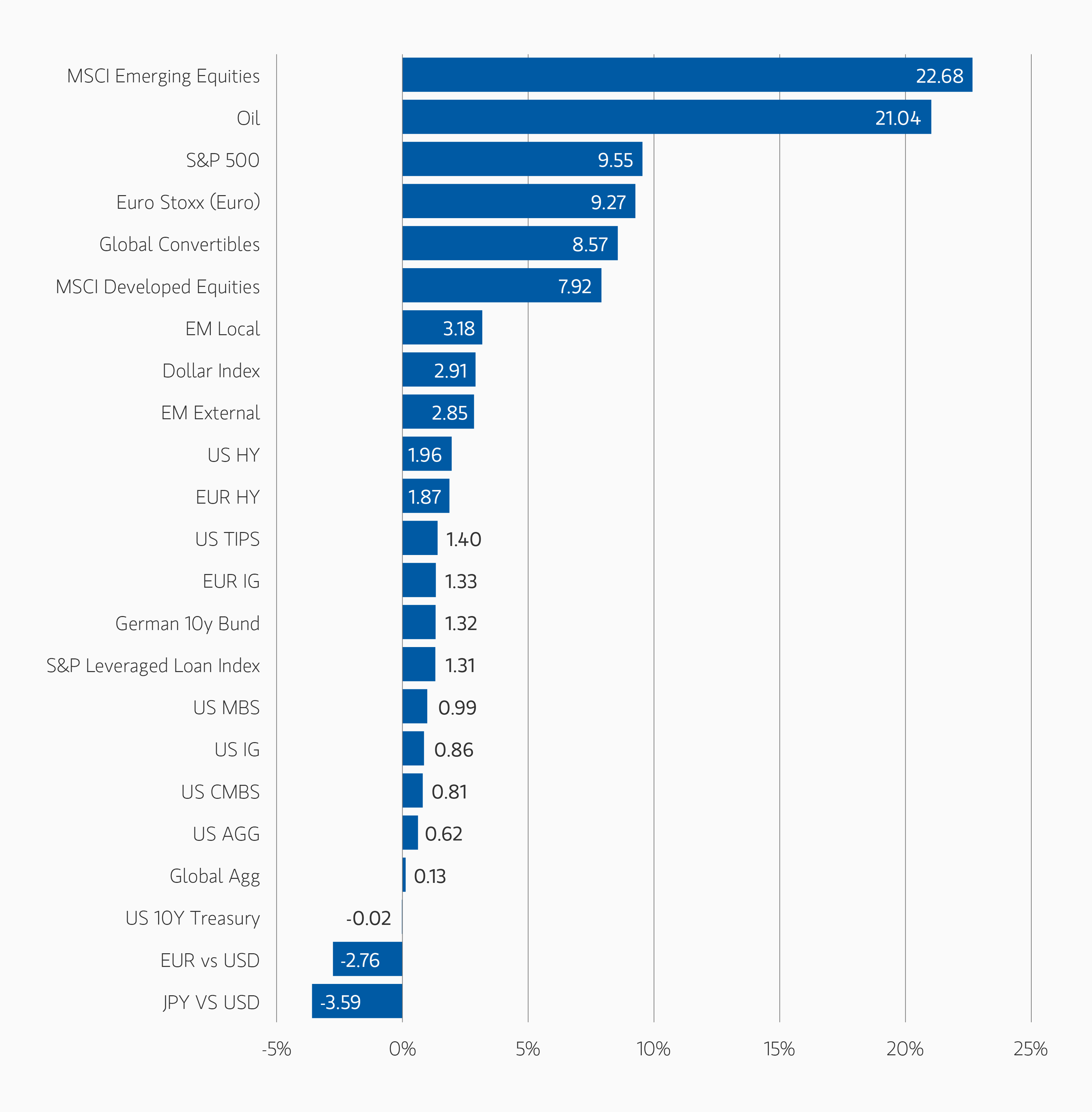
Note: USD-based performance. Source: Bloomberg. Data as of June 30, 2026. The indexes are provided for illustrative purposes only and are not meant to depict the performance of a specific investment. Past performance is no guarantee of future results. See below for index definitions.
Display 1: Asset Performance Year-to-Date
Display 2: Currency Monthly Changes versus USD
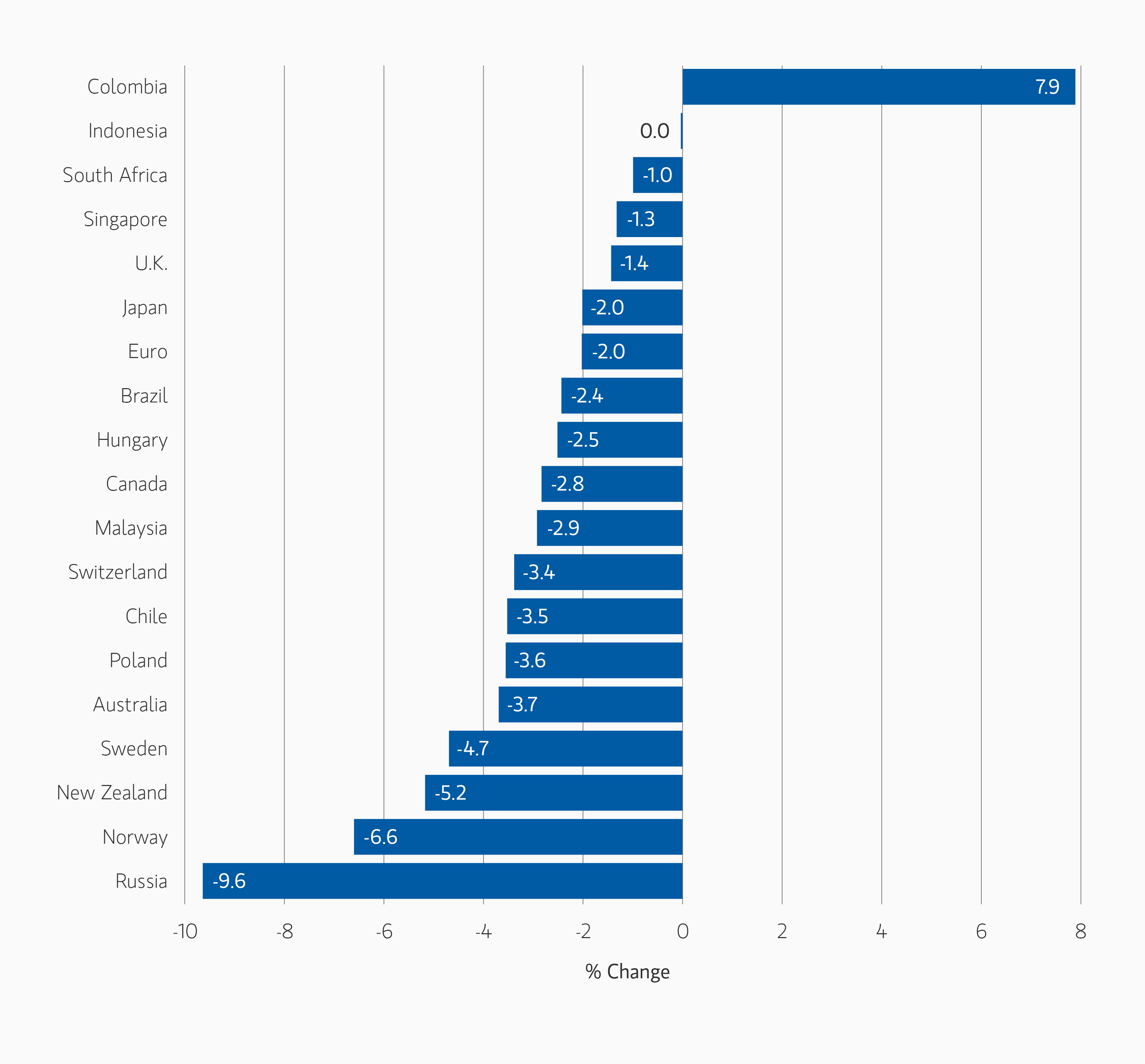
Note: Positive change means appreciation of the currency against the USD. Source: Bloomberg. Data as June 30, 2026.
Display 2: Currency Monthly Changes versus USD
Display 3: Major Monthly Changes in 10-Year Yields and Spreads
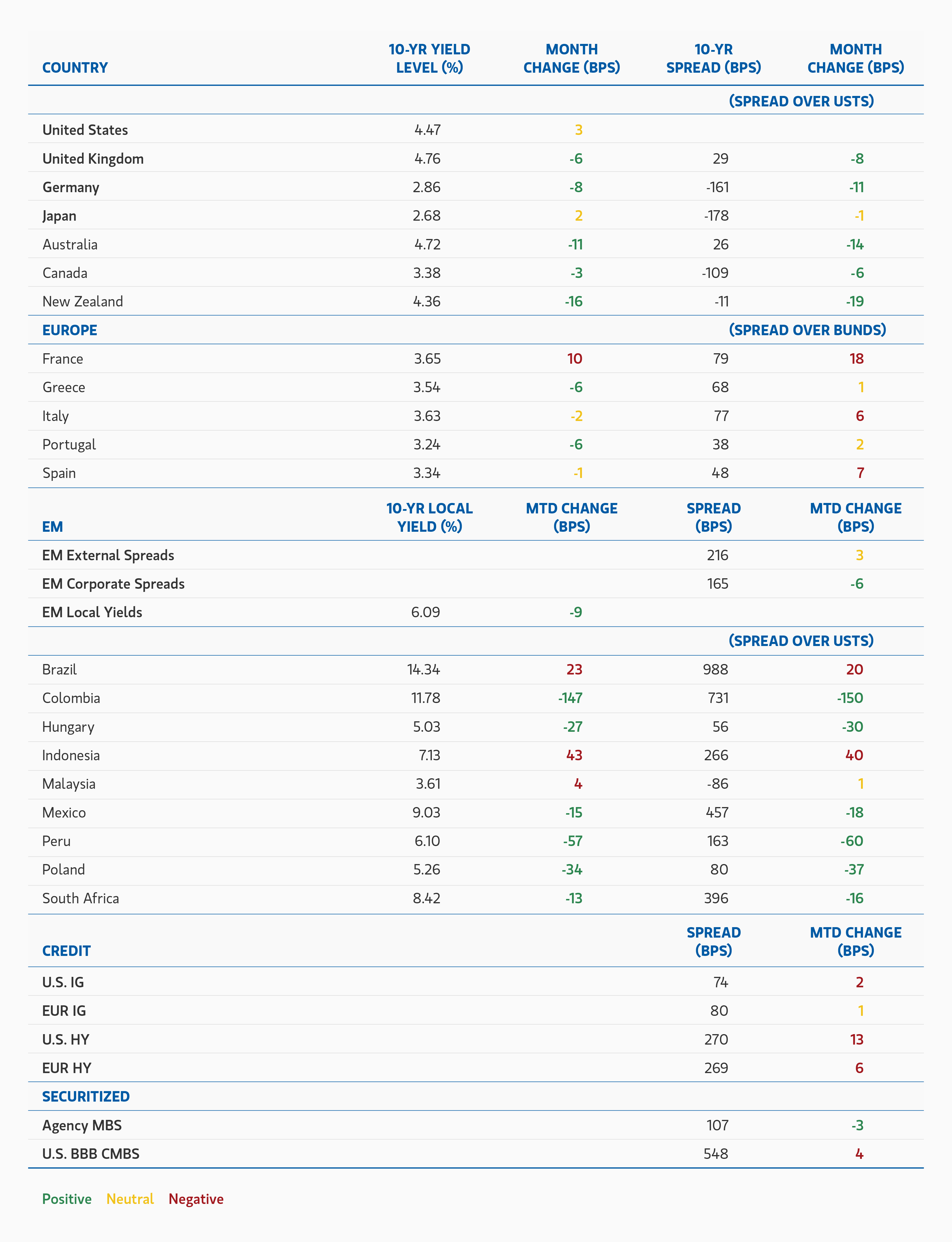
Source: Bloomberg, JPMorgan. Data as of June 30, 2026
Display 3: Major Monthly Changes in 10-Year Yields and Spreads
Broad Markets Fixed Income Global Asset Allocation and Outlook
Developed Market Rate/Foreign Currency
(Long duration, neutral curve positioning, selective high-carry FX)
The sector views above are grounded in a macro environment where country differentiation is becoming increasingly important. The market narrative has continued to shift away from recession concerns and toward the durability of growth and inflation. In the U.S., stronger-than-expected labor-market data, resilient consumption, and firm inflation readings have led investors to reprice monetary-policy expectations toward a more restrictive path than was expected at the beginning of the year. Elsewhere in developed markets, much of this repricing occurred earlier, though inflation and energy-related risks continue to influence central-bank expectations.
Against this backdrop, we maintain a long-duration stance across developed markets, though positioning remains selective and focused on regions where growth appears more vulnerable to tighter financial conditions and where valuations are compelling. Exposure is concentrated in front-end rates markets outside the United States, alongside a long position in U.S. Treasury Inflation-Protected Securities (TIPS).
Inflation remains the primary macro risk. Although longer-dated inflation expectations have retraced modestly, core inflation measures and producer-price pressures remain firm. We therefore maintain some exposure to U.S. inflation-linked markets, where we continue to see value in hedging portfolios against the risk that inflation remains above central-bank targets for longer than currently anticipated.
Curve dynamics have generally stabilized following the sharp repricing earlier in the year, and we remain neutral on outright curve positioning. While elevated fiscal deficits, AI-related investment spending, and energy-market uncertainty continue to support higher term premia over the medium term, recent moves have reduced the attractiveness of broad directional curve expressions.
In foreign exchange, we continue to favor selective high-carry emerging market currencies where fundamentals and valuations remain supportive. Positioning is focused on differentiated opportunities in emerging markets (EM) where carry characteristics and domestic drivers remain attractive with funding of long positions moved partially away from U.S. dollar to lower yielding and lower growth European currencies More broadly, we expect currency markets to remain highly sensitive to evolving central-bank expectations, energy prices, and geopolitical developments, with relative growth and inflation dynamics continuing to drive performance across developed and emerging markets.
Emerging Market Debt
(Overweight)
Emerging market sovereign and corporate debt remains an attractive opportunity, supported by elevated real yields, resilient technicals, and improving fundamentals in select countries. Despite persistent geopolitical uncertainty and a more hawkish global policy backdrop, EM credit markets have remained broadly resilient, with spreads continuing to retrace in several regions.
Carry and income remain central drivers of expected returns, though country selection remains critical given elevated dispersion across regions. Higher energy prices continue to create divergence between commodity exporters and importers, while local political developments remain an important source of idiosyncratic opportunity and risk. Recent developments across markets such as Colombia, Hungary, Indonesia, and the Philippines highlight the differentiated nature of the opportunity set.
Valuations remain attractive across select local and hard-currency markets, and many EM currencies continue to offer compelling carry relative to developed markets. While tighter global financial conditions and persistent inflation remain important risks, we continue to favor countries with credible monetary frameworks, improving fundamentals, and attractive real-yield differentials. In an environment where global growth remains positive and default risks remain contained, we believe the asset class continues to offer attractive risk-adjusted return potential.
Corporate Credit
(Underweight IG, small overweight HY)
We remain underweight investment grade (IG) corporates due to tight valuations and limited room for broad-based spread compression. Credit markets have been resilient, supported by strong demand for all-in yield, healthy corporate fundamentals, and exceptional technicals. Both U.S. and European IG markets have absorbed elevated issuance with little disruption, as strong inflows and investor demand have offset heavy supply. However, at current spread levels, carry is the primary driver of expected returns, and even modest spread widening could erode excess return potential.
Fundamentals remain solid, with healthy balance sheets, low downgrade risk, and generally resilient earnings. That said, the market is increasingly entering a later-cycle phase characterized by elevated M&A activity, AI- and infrastructure-related capital expenditure, and higher shareholder distributions. AI-related financing has continued to accelerate, particularly among large technology and hyperscale issuers, reinforcing expectations that infrastructure spending will remain an important driver of corporate issuance.
Regionally, we continue to prefer Europe over the U.S., supported by more balanced supply dynamics and stronger demand for high-quality carry. From a sector perspective, we continue to favor financials, particularly banks, given robust capital positions, solid liquidity, and resilient earnings. We remain more cautious on single-A non-financials, where M&A risk, shareholder-friendly activity, and capex needs could create greater balance-sheet pressure.
We maintain a modest overweight to select high-yield issuers in both the U.S. and Europe. High yield has performed well, supported by resilient growth, strong labor markets, continued fiscal support, and robust demand for income. Although spreads remain historically tight and issuance has accelerated, fundamentals remain supportive, with improved average credit quality, manageable leverage, and contained default expectations.
We continue to believe a meaningful demand-destruction scenario is not the base case. Low but positive economic growth, supported by fiscal spending, energy-related investment, and continued AI and infrastructure capex, remains consistent with a broadly benign default environment. However, with much of the good news already reflected in valuations, selectivity is increasingly important.
Elevated dispersion across sectors and issuers continues to create opportunities for active positioning. We favor businesses with resilient cash flows, strong pricing power, lower refinancing risk, and less exposure to cyclical demand pressure. While high-yield spreads leave limited margin for error, the yield per unit of spread-duration risk remains compelling for investors, particularly relative to investment grade credit.
Leveraged Loans
(Neutral)
We have moved to a more neutral stance on leveraged loans as increased dispersion and spread widening have improved valuations across parts of the market. The asset class remains characterized by selective technicals and meaningful issuer-level differentiation, but valuations have become more attractive, particularly relative to high-yield corporates. CLO demand continues to provide an important source of support, while investor preference remains focused on higher-quality issuers and more resilient sectors.
Software and technology-linked issuers remain an area of caution given ongoing uncertainty around AI-related disruption. However, the broad-based selloff across parts of the sector has also created selective opportunities where market pricing appears disconnected from underlying fundamentals. In several cases, investors have reduced exposure indiscriminately, creating attractive entry points in higher-quality, mission-critical businesses with durable cash flows, proprietary data advantages, and high switching costs.
More broadly, economically sensitive sectors continue to face pressure from elevated financing costs, inflation uncertainty, and rising input costs, even as overall corporate fundamentals remain relatively stable. CLO issuance and demand for floating-rate exposure remain supportive, helping offset more mixed retail flows. While selectivity remains paramount, current valuations increasingly compensate investors for refinancing risk and macro uncertainty in higher-quality segments of the market.
Securitized Products
(Overweight)
Agency mortgage-backed securities (MBS) and non-agency residential mortgage-backed securities (RMBS) remain a high-conviction overweight. Agency MBS experienced periods of volatility as rates markets adjusted to changing inflation and policy expectations, but spreads retraced much of their widening as demand remained strong and mortgage rates moved off recent highs. Relative valuations continue to appear attractive in the current coupon pools versus both historical levels and other core fixed income sectors. Higher for longer rates backdrop is likely going to keep prepayment risks at bay, favoring yield pick-up over treasuries.
Technical conditions remain supportive. Demand for high-quality collateral continues to benefit from attractive all-in yields, strong money manager demand, and increasing participation from banks and government-sponsored enterprises (GSEs) as balance sheet constraints ease and relative value improves. The Federal Reserve’s measured balance sheet runoff continues to limit net supply pressure, while demand from banks and other buyers has helped offset supply created by runoff.
Non-agency RMBS continues to offer one of the more attractive opportunity sets within structured credit. Stable home prices, low loan-to-value ratios, improving collateral performance, and limited refinancing risk continue to support fundamentals. Strong issuance growth has been met with robust investor demand, particularly in residential credit sectors where recent vintages continue to demonstrate favorable performance characteristics.
Lastly, we remain constructive on Danish covered bonds, where defensive characteristics, strong legal frameworks, and attractive USD-hedged yields continue to support relative value.
Commercial mortgage-backed securities (CMBS) remain an attractive area of structured credit, though selectivity remains critical. Fundamentals are resilient in higher-quality segments, and strong technical demand has continued to support the sector despite the higher-rate environment. We continue to favor exposure to hospitality, logistics, storage, and high-quality multifamily assets, where operating performance and collateral quality remain comparatively strong.
Issuance across securitized markets, including CMBS, has remained robust via the single asset single borrower (SASB) market, but many transactions have been well absorbed and heavily oversubscribed, reinforcing the strength of investor demand. While improving sentiment has created opportunities, dispersion across property types, locations, and capital structures remains elevated. We continue to focus on higher-quality transactions and structures where collateral performance, borrower sponsorship, and cash-flow visibility provide stronger downside protection.
Asset-backed securities (ABS) remain supported by strong demand, attractive carry, and the sector’s generally shorter-duration profile. Issuance has been robust, but demand for high-quality securitized collateral has remained resilient, helping spreads stay well contained despite elevated supply. We continue to view the sector as a useful source of diversification and income in an environment where carry is expected to be a dominant driver of returns.
We continue to see opportunities in select non-consumer ABS where fundamentals remain stable and valuations are still attractive. We remain more cautious on areas where projected supply, technology disruption, or uncertain long-term economics are not adequately reflected in spreads.
We also remain constructive on Danish covered bonds, where defensive characteristics, strong legal frameworks, and attractive USD-hedged yields continue to support relative value.
Featured Insights







 This image indicates content designed specifically for Financial Advisors / Investment Professionals. This material is not to be used with the public.