



Markets may seem chaotic now, but we don’t see it that way. Our view is that we are witnessing a major structural change, one with a magnitude that might be observed once in 100 years. This type of structural change puts money in motion and provides an investment opportunity to get ahead of that money, not merely follow it.
But this requires a conceptual framework to have this understanding. Let me explain.
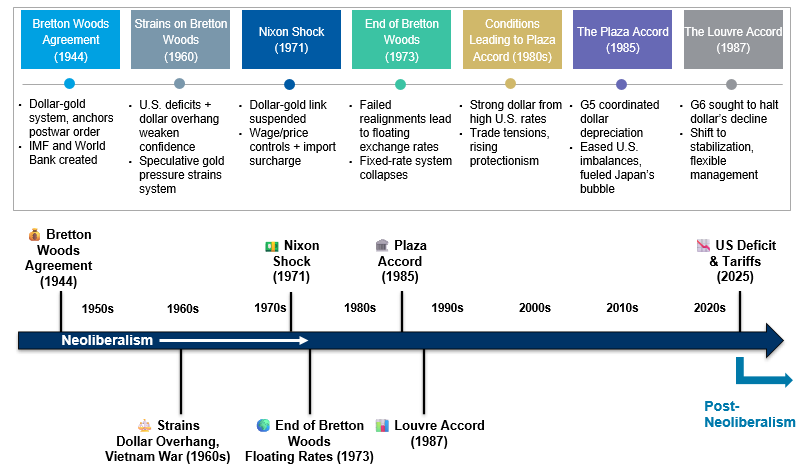
For the past few generations, we have been living in a post-Bretton Woods financial era. If you ever took an economics course, you likely heard about Bretton Woods, NH, where in 1944 allied nations came together to decide on a post-war order designed to rebuild global economies. Since the U.S. would clearly emerge as the strongest economy, the U.S. dollar (USD) should then be as strong, designating it as the reserve currency and fully convertible into gold. This meant other currencies would be weaker, enabling these countries to rebuild their export base, manufacturing and economies much more easily.
The agreement was necessary and sound, but with one major drawback: It meant the U.S. would likely run a deficit, something that would need to be handled competently in the post-Bretton Woods period. In fact, the management of this deficit has been the crux of major geo-economic events since the end of World War II (Display 1).
By the late 1960s the U.S. was embroiled in the Vietnam War and faced with a rising deficit. Many other countries saw this as an opportunity to convert their USD into gold, such that U.S. gold reserves dropped precipitously. In the early 1970s U.S. President Nixon considered this a serious threat to national security and terminated the Bretton Woods agreement and the easy conversions. This was a major economic event that ushered in fiat money (i.e., money created and backed by a government) and became know as the Bretton Woods II era.
But this only addressed the U.S. deficit temporarily. By the early 1980s the U.S. found itself once again with a growing deficit and called a meeting with large-economy trading partners at the Plaza Hotel in New York City. Another agreement was then reached in 1985 to use foreign exchange intervention to reduce the value of the USD and strengthen foreign currencies. It was known as the Plaza Accord.
The Plaza Accord created debilitating economic volatility across financial markets, and was ultimately viewed as a major policy failure. Things became so chaotic that a mere two years later nations met again, this time at the Louvre in Paris, to dismantle the Plaza Accord and vowing never again to use major currency interventions to address the U.S. deficit. The Louvre Accord was brought to life in 1987.
Regardless of the new approach, the U.S. deficit remained an endemic risk to post-Bretton Woods policy. In 2001 China joined the World Trade Organization and deficits continued to grow. Beyond that, the demographic challenges of an aging population significantly worsened the trajectory of the deficit.
So how can deficit risk be addressed if one chooses not to use currency policy?
Tariffs.
The use of tariffs meant a return to the pre-Bretton Woods period and how countries interacted with each other for hundreds of years prior. U.S. tariff policy was introduced by President Trump in his first term, continued by President Biden and then reaccelerated in Trump’s second term. In fact, subsequent presidents are likely to keep tariffs in place. Why? Because the U.S. deficit will remain a problem for the next few generations as the Baby Boomers age, with the larger Millennial cohort soon thereafter. The U.S. is not alone in this demographic challenge; it’s a global phenomenon.
Admittedly, this is a highly rudimentary summary of the past 80 years. And to be sure, there are many ways to address a deficit beyond just tariffs, with responsible spending by governments at the top of the list. But least painful for elected leaders are tariffs, which is why we think they remain the default choice. After all, there are hundreds of years of economic history prior to Bretton Woods to support this.
A Conceptual Framework to Invest Ahead of the Money
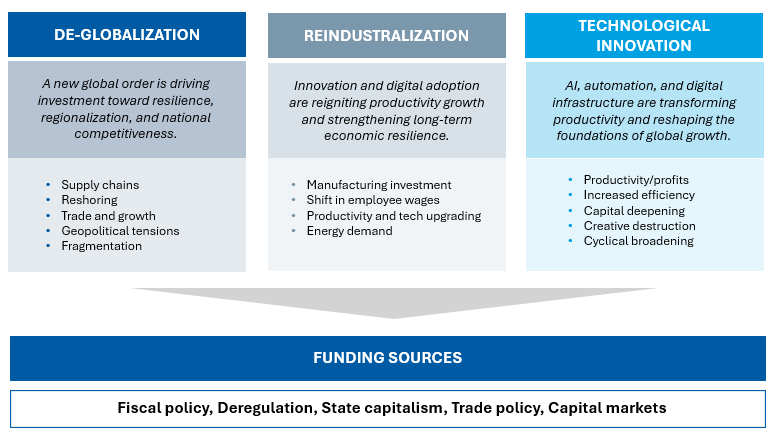
In addition to tariffs (and responsible spending), there is another way to address deficits, namely economic growth policies. This is where we find ourselves today, with country leaders understanding that the construct of economic trade and growth will change in the future. It’s a race that has already started and like any race, one wants to have a great pole position at the start. This is why both foreign and trade policies are currently in flux.
As you can see in Display 2, we have built a conceptual framework for what we believe comes next, one that breaks down into four investable themes:
Finding Clarity Out of Chaos:
Using Our Conceptual Framework to Identify Investment Opportunities
If we believe that policy is going to support these structural changes then we can use large language models to understand global policies and identify sectors and industries that may benefit most. We can do the same with deregulation.
There are many ways we leverage this conceptual framework to inform our decision making through investment selection of managers, ETFs and baskets of equities. Both passive and active investments have a role to play. Similarly, we use this to bolster our understanding of growth and inflation that impacts our management of fixed income assets. We find ways to use both active and passive management from our investment selection and quantitative research to optimize portfolio construction and position sizing. This is what we are embedding into our strategies.
Structural changes of this magnitude will put money in motion, and our strategy is to get ahead of the money, not follow it.
The Portfolio Solutions Group is a comprehensive multi-asset business, with activity across all asset strategies and types (traditional and alternative), through solutions that span fully liquid (public assets), comprehensive (public and private assets) and fully private portfolios. Offerings are delivered via a managed portfolio or model, in discretionary or advisory format.
RISK CONSIDERATIONS
Diversification does not eliminate the risk of loss. There is no assurance that the Strategy will achieve its investment objective. Portfolios are subject to market risk, which is the possibility that the market values of securities owned by the portfolio will decline and that the value of portfolio shares may therefore be less than what you paid for them. Market values can change daily due to economic and other events (e.g. natural disasters, health crises, terrorism, conflicts and social unrest) that affect markets, countries, companies or governments. It is difficult to predict the timing, duration, and potential adverse effects (e.g. portfolio liquidity) of events. Accordingly, you can lose money investing in this portfolio. Please be aware that this strategy may be subject to certain additional risks. The success or failure of such decisions will affect performance. Active Management: in pursuing the Portfolio’s investment objective, the Adviser has considerable leeway in deciding which investments to buy, hold or sell on a day-to-day basis, and which trading strategies to use. There is the risk that the Adviser’s asset allocation methodology and assumptions regarding the Underlying Portfolios may be incorrect in light of actual market conditions and the Portfolio may not achieve its investment objective. Share prices also tend to be volatile and there is a significant possibility of loss. The portfolio’s investments in commodity-linked notes involve substantial risks, including risk of loss of a significant portion of their principal value. In addition to commodity risk, they may be subject to additional special risks, such as risk of loss of interest and principal, lack of secondary market and risk of greater volatility, that do not affect traditional equity and debt securities. Currency fluctuations could erase investment gains or add to investment losses. Fixed-income securities are subject to the ability of an issuer to make timely principal and interest payments (credit risk), changes in interest rates (interest-rate risk), the creditworthiness of the issuer and general market liquidity (market risk). In a rising interest-rate environment, bond prices may fall and may result in periods of volatility and increased portfolio redemptions. In a declining interest-rate environment, the portfolio may generate less income. Longer-term securities may be more sensitive to interest rate changes. Equity and foreign securities are generally more volatile than fixed income securities and are subject to currency, political, economic and market risks. Equity values fluctuate in response to activities specific to a company. Stocks of small-capitalization companies carry special risks, such as limited product lines, markets and financial resources, and greater market volatility than securities of larger, more established companies. The risks of investing in emerging market countries are greater than risks associated with investments in foreign developed markets. Exchange traded funds (ETFs) shares have many of the same risks as direct investments in common stocks or bonds and their market value will fluctuate as the value of the underlying index does. By investing in exchange traded funds ETFs and other Investment Funds, the portfolio absorbs both its own expenses and those of the ETFs and Investment Funds it invests in. Supply and demand for ETFs and Investment Funds may not be correlated to that of the underlying securities. Derivative instruments can be illiquid, may disproportionately increase losses and may have a potentially large negative impact on the portfolio’s performance. A currency forward is a hedging tool that does not involve any upfront payment. The use of leverage may increase volatility in the Portfolio.
IMPORTANT DISCLOSURES:
Past performance is no guarantee of future results. The returns referred to in the audio are those of representative indices and are not meant to depict the performance of a specific investment.
There is no guarantee that any investment strategy will work under all market conditions, and each investor should evaluate their ability to invest for the long-term, especially during periods of downturn in the market.
A separately managed account may not be appropriate for all investors. Separate accounts managed according to the particular Strategy may include securities that may not necessarily track the performance of a particular index. Please consider the investment objectives, risks and fees of the Strategy carefully before investing. A minimum asset level is required.
For important information about the investment managers, please refer to Form ADV Part 2.
The views and opinions and/or analysis expressed are those of the author or the investment team as of the date of preparation of this material and are subject to change at any time without notice due to market or economic conditions and may not necessarily come to pass. Furthermore, the views will not be updated or otherwise revised to reflect information that subsequently becomes available or circumstances existing, or changes occurring, after the date of publication. The views expressed do not reflect the opinions of all investment personnel at Morgan Stanley Investment Management (MSIM) and its subsidiaries and affiliates (collectively “the Firm”), and may not be reflected in all the strategies and products that the Firm offers.
Forecasts and/or estimates provided herein are subject to change and may not actually come to pass. Information regarding expected market returns and market outlooks is based on the research, analysis and opinions of the authors or the investment team. These conclusions are speculative in nature, may not come to pass and are not intended to predict the future performance of any specific strategy or product the Firm offers. Future results may differ significantly depending on factors such as changes in securities or financial markets or general economic conditions.
This material has been prepared on the basis of publicly available information, internally developed data and other third-party sources believed to be reliable. However, no assurances are provided regarding the reliability of such information and the Firm has not sought to independently verify information taken from public and third-party sources.
This material is for the benefit of persons whom the Firm reasonably believes it is permitted to communicate to and should not be forwarded to any other person without the consent of the Firm. It is not addressed to any other person and may not be used by them for any purpose whatsoever. It expresses no views as to the suitability of the investments described herein to the individual circumstances of any recipient or otherwise. It is the responsibility of every person reading this material to fully observe the laws of any relevant country, including obtaining any governmental or other consent which may be required or observing any other formality which needs to be observed in that country.
This material is a general communication, which is not impartial and all information provided has been prepared solely for informational and educational purposes and does not constitute an offer or a recommendation to buy or sell any particular security or to adopt any specific investment strategy. The information herein has not been based on a consideration of any individual investor circumstances and is not investment advice, nor should it be construed in any way as tax, accounting, legal or regulatory advice. To that end, investors should seek independent legal and financial advice, including advice as to tax consequences, before making any investment decision.
The indexes are unmanaged and do not include any expenses, fees or sales charges. It is not possible to invest directly in an index. Any index referred to herein is the intellectual property (including registered trademarks) of the applicable licensor. Any product based on an index is in no way sponsored, endorsed, sold or promoted by the applicable licensor and it shall not have any liability with respect thereto.
This material is not a product of Morgan Stanley’s Research Department and should not be regarded as a research material or a recommendation.
The Firm has not authorised financial intermediaries to use and to distribute this material, unless such use and distribution is made in accordance with applicable law and regulation. Additionally, financial intermediaries are required to satisfy themselves that the information in this material is appropriate for any person to whom they provide this material in view of that person’s circumstances and purpose. The Firm shall not be liable for, and accepts no liability for, the use or misuse of this material by any such financial intermediary.
This material may be translated into other languages. Where such a translation is made this English version remains definitive. If there are any discrepancies between the English version and any version of this material in another language, the English version shall prevail.
The whole or any part of this material may not be directly or indirectly reproduced, copied, modified, used to create a derivative work, performed, displayed, published, posted, licensed, framed, distributed or transmitted or any of its contents disclosed to third parties without the Firm’s express written consent. This material may not be linked to unless such hyperlink is for personal and non-commercial use. All information contained herein is proprietary and is protected under copyright and other applicable law.
Eaton Vance is part of Morgan Stanley Investment Management. Morgan Stanley Investment Management is the asset management division of Morgan Stanley.
DISTRIBUTION
This material is only intended for and will only be distributed to persons resident in jurisdictions where such distribution or availability would not be contrary to local laws or regulations.
MSIM, the asset management division of Morgan Stanley (NYSE: MS), and its affiliates have arrangements in place to market each other’s products and services. Each MSIM affiliate is regulated as appropriate in the jurisdiction it operates. MSIM’s affiliates are: Calvert Research and Management, Eaton Vance Management, Parametric Portfolio Associates LLC, Parametric SAS, and Atlanta Capital Management LLC.
This material has been issued by any one or more of the following entities:
EMEA:
This material is for Professional Clients/Accredited Investors only.
In the EU, MSIM materials are issued by MSIM Fund Management (Ireland) Limited (“FMIL”). FMIL is regulated by the Central Bank of Ireland and is incorporated in Ireland as a private company limited by shares with company registration number 616661 and has its registered address at 24-26 City Quay, Dublin 2, DO2 NY19, Ireland.
Outside the EU, MSIM materials are issued by Morgan Stanley Investment Management Limited (MSIM Ltd) is authorised and regulated by the Financial Conduct Authority. Registered in England. Registered No. 1981121. Registered Office: 25 Cabot Square, Canary Wharf, London E14 4QA.
In Switzerland, MSIM materials are issued by Morgan Stanley & Co. International plc, London (Zurich Branch) Authorised and regulated by the Eidgenössische Finanzmarktaufsicht ("FINMA"). Registered Office: Beethovenstrasse 33, 8002 Zurich, Switzerland.
Italy: MSIM FMIL (Milan Branch), (Sede Secondaria di Milano) Palazzo Serbelloni Corso Venezia, 16 20121 Milano, Italy. The Netherlands: MSIM FMIL (Amsterdam Branch), Rembrandt Tower, 11th Floor Amstelplein 1 1096HA, Netherlands. France: MSIM FMIL (Paris Branch), 61 rue de Monceau 75008 Paris, France. Spain: MSIM FMIL (Madrid Branch), Calle Serrano 55, 28006, Madrid, Spain. Germany: MSIM FMIL, Frankfurt Branch, Grosse Gallusstrasse 18, 60312 Frankfurt am Main, Germany (Gattung: Zweigniederlassung (FDI) gem. § 53b KWG). Denmark: MSIM FMIL (Copenhagen Branch), Gorrissen Federspiel, Axel Towers, Axeltorv2, 1609 Copenhagen V, Denmark.
MIDDLE EAST:
Dubai International Financial Centre: This information does not constitute or form part of any offer to issue or sell, or any solicitation of any offer to subscribe for or purchase, any securities or investment products in the UAE (including the Dubai International Financial Centre and the Abu Dhabi Global Market) and accordingly should not be construed as such. Furthermore, this information is being made available on the basis that the recipient acknowledges and understands that the entities and securities to which it may relate have not been approved, licensed by or registered with the UAE Central Bank, the Dubai Financial Services Authority, the UAE Securities and Commodities Authority, the Financial Services Regulatory Authority or any other relevant licensing authority or government agency in the UAE. The content of this report has not been approved by or filed with the UAE Central Bank, the Dubai Financial Services Authority, the UAE Securities and Commodities Authority or the Financial Services Regulatory Authority.
Abu Dhabi Global Market ("ADGM"): This material is sent strictly within the context of, and constitutes, an Exempt Communication. This material relates to content which is not subject to any form of regulation or approval by the Financial Services Regulatory Authority of the Abu Dhabi Global Market (the “FSRA”).
Saudi Arabia: This financial promotion was issued and approved for use in Saudi Arabia by Morgan Stanley Saudi Arabia, Al Rashid Tower, Kings Sand Street, Riyadh, Saudi Arabia, authorized and regulated by the Capital Market Authority license number 06044-37.
U.S.: NOT FDIC INSURED | OFFER NO BANK GUARANTEE | MAY LOSE VALUE | NOT INSURED BY ANY FEDERAL GOVERNMENT AGENCY | NOT A DEPOSIT
Latin America (Brazil, Chile Colombia, Mexico, Peru, and Uruguay)
This material is for use with an institutional investor or a qualified investor only. All information contained herein is confidential and is for the exclusive use and review of the intended addressee, and may not be passed on to any third party. This material is provided for informational purposes only and does not constitute a public offering, solicitation or recommendation to buy or sell for any product, service, security and/or strategy. A decision to invest should only be made after reading the strategy documentation and conducting in-depth and independent due diligence.
ASIA PACIFIC
Hong Kong: This material is disseminated by Morgan Stanley Asia Limited for use in Hong Kong and shall only be made available to “professional investors” as defined under the Securities and Futures Ordinance of Hong Kong (Cap 571). The contents of this material have not been reviewed nor approved by any regulatory authority including the Securities and Futures Commission in Hong Kong. Accordingly, save where an exemption is available under the relevant law, this material shall not be issued, circulated, distributed, directed at, or made available to, the public in Hong Kong. Singapore: This material is disseminated by Morgan Stanley Investment Management Company and should not be considered to be the subject of an invitation for subscription or purchase, whether directly or indirectly, to the public or any member of the public in Singapore other than (i) to an institutional investor under section 304 of the Securities and Futures Act, Chapter 289 of Singapore (“SFA”); (ii) to a “relevant person” (which includes an accredited investor) pursuant to section 305 of the SFA, and such distribution is in accordance with the conditions specified in section 305 of the SFA; or (iii) otherwise pursuant to, and in accordance with the conditions of, any other applicable provision of the SFA. This publication has not been reviewed by the Monetary Authority of Singapore. Australia: This material is provided by Morgan Stanley Investment Management (Australia) Pty Ltd ABN 22122040037, AFSL No. 314182 and its affiliates and does not constitute an offer of interests. Morgan Stanley Investment Management (Australia) Pty Limited arranges for MSIM affiliates to provide financial services to Australian wholesale clients. This material will not be lodged with the Australian Securities and Investments Commission.
Japan: For professional investors, this material is circulated or distributed for informational purposes only. For those who are not professional investors, this material is provided in relation to Morgan Stanley Investment Management (Japan) Co., Ltd. (“MSIMJ”)’s business with respect to discretionary investment management agreements (“IMA”) and investment advisory agreements (“IAA”). This is not for the purpose of a recommendation or solicitation of transactions or offers any particular financial instruments. Under an IMA, with respect to management of assets of a client, the client prescribes basic management policies in advance and commissions MSIMJ to make all investment decisions based on an analysis of the value, etc. of the securities, and MSIMJ accepts such commission. The client shall delegate to MSIMJ the authorities necessary for making investment. MSIMJ exercises the delegated authorities based on investment decisions of MSIMJ, and the client shall not make individual instructions. All investment profits and losses belong to the clients; principal is not guaranteed. Please consider the investment objectives and nature of risks before investing. As an investment advisory fee for an IAA or an IMA, the amount of assets subject to the contract multiplied by a certain rate (the upper limit is 2.20% per annum (including tax)) shall be incurred in proportion to the contract period. For some strategies, a contingency fee may be incurred in addition to the fee mentioned above. Indirect charges also may be incurred, such as brokerage commissions for incorporated securities. Since these charges and expenses are different depending on a contract and other factors, MSIMJ cannot present the rates, upper limits, etc. in advance. All clients should read the Documents Provided Prior to the Conclusion of a Contract carefully before executing an agreement. This material is disseminated in Japan by MSIMJ, Registered No. 410 (Director of Kanto Local Finance Bureau (Financial Instruments Firms)), Membership: the Japan Securities Dealers Association, The Investment Trusts Association, Japan, the Japan Investment Advisers Association and the Type II Financial Instruments Firms Association.
FINRA BrokerCheck. Investors may check the background of their Investment Professional by contacting the Financial IndustryRegulatory Authority (FINRA). FINRA BrokerCheck is a free tool to help investors check the professional background of current andformer FINRA-registered securities firms and brokers. FINRA BrokerCheck is available by calling 1-800-289-9999 and at www.FINRA.org. The FINRA BrokerCheck brochure describing this program is available to investors at www.FINRA.org.
To report a website vulnerability, please go to Responsible Disclosure.
Eaton Vance, Atlanta Capital, Parametric and Calvert are part of Morgan Stanley Investment Management. Morgan Stanley Investment Management is the asset management division of Morgan Stanley.
MSIM, the asset management division of Morgan Stanley (NYSE: MS), and its affiliates have arrangements in place to market each other’s products and services. Each MSIM affiliate is regulated as appropriate in the jurisdiction it operates. MSIM’s affiliates are: Eaton Vance Management (International) Limited, Eaton Vance Advisers International Ltd, Calvert Research and Management, Eaton Vance Management, Parametric Portfolio Associates LLC, and Atlanta Capital Management LLC.
For USA PATRIOT Act Disclosure Notice please click here.
This image indicates content designed specifically for Financial Advisors / Investment Professionals. This material is not to be used with the public.
Before investing in any Eaton Vance, Calvert or Morgan Stanley Investment Management Inc.-advised fund, prospective investors should consider carefully the investment objective(s), risks, and charges and expenses. Read the prospectus carefully before you invest or send money. For open-end mutual funds, the current prospectus contains this and other information. To obtain an open-end mutual fund prospectus or summary prospectus and the most recent annual and semiannual shareholder reports, contact your financial advisor or download a copy here. For closed-end funds, you should contact your financial advisor. To obtain the most recent annual and semi-annual shareholder report for a closed-end fund contact your financial advisor or download a copy here. To obtain an exchange-traded fund, ("ETF") prospectus or summary prospectus, contact your financial advisor or download a copy here.
Before purchasing any variable product, consider the objectives, risks, charges, and expenses associated with the underlying investment option(s) and those of the product itself. For a prospectus containing this and other information, contact your investment or insurance professional. Read the prospectus carefully before investing.
See the Fund's prospectus for information related to a primary benchmark index selected (if applicable) to comply with a regulation that requires the Fund's primary benchmark to represent the overall applicable market.
Morgan Stanley Investment Management does not provide tax or legal advice. Prospective investors should consult with a tax or legal advisor before making any investment decision. The information on this Web page is for U.S. residents only and does not constitute an offer to sell, or a solicitation of an offer to purchase, securities in any jurisdiction to any person to whom it is not lawful to make such an offer.
© Eaton Vance Management. All rights reserved.
Morgan Stanley Distribution, Inc. serves as the distributor for Morgan Stanley Funds. Morgan Stanley Distribution, Inc. Member FINRA / SIPC. Eaton Vance open-end mutual funds are offered through Eaton Vance Distributors, Inc. One Post Office Square, Boston, MA 02109. Member FINRA/SIPC. Exchange-traded funds are distributed by Foreside Fund Services, LLC.
NOT FDIC INSURED | OFFER NO BANK GUARANTEE | MAY LOSE VALUE | NOT INSURED BY ANY FEDERAL GOVERNMENT AGENCY | NOT A DEPOSIT