




 Top


Authors:
Katryna Littell, Vice President, Municipals
Chloe Waldron, Research Associate, Municipals
News headlines about AI-related data center investment generally emphasize its projected scale. For municipal investors, the key question is who pays for the energy infrastructure supporting these facilities and what structural credit protections exist if anticipated demand falls short.
What the municipal market is financing
Generally, municipal debt does not finance data centers. Technology companies, typically large cloud and AI operators known as hyperscalers, fund the campus, servers and technology privately. The municipal market is more likely to finance the long-lived public infrastructure that supports such facilities: power generation, transmission, substations, grid upgrades, water and wastewater capacity. Morgan Stanley Research projects roughly $100 billion of potential AI-linked municipal issuance through 2030, including about $20 billion from public power systems. Data centers can create exceptionally large power and infrastructure needs. Public power systems, typically municipal utilities, may have to build capacity before they have a sufficient customer and revenue base to support the outlays. Because this infrastructure lasts for decades, debt is a natural fit, and long-term municipal bonds let issuers amortize the cost over its lifespan.
How power projects are financed
Public power systems typically issue revenue bonds backed by utility-system revenues to fund infrastructure ventures. Ideally, the project is structured so the entities requiring the new capacity are made contractually responsible for the added costs, rather than existing residential and commercial ratepayers.
In this scenario, a thorough credit analysis should focus on the entity that signs the contract, rather than the data center operator. The involvement of a well-known technology company is not a guarantee that investors will be repaid because it may not be the primary offtaker, the customer contractually required to buy the project’s output.
Instead, investors may want to zero in on the offtaker’s creditworthiness, payment terms, contract length, any parent company support and the consequences of termination. These are credit factors that ultimately help support the repayment of the bonds.
Key Structural Credit Protections
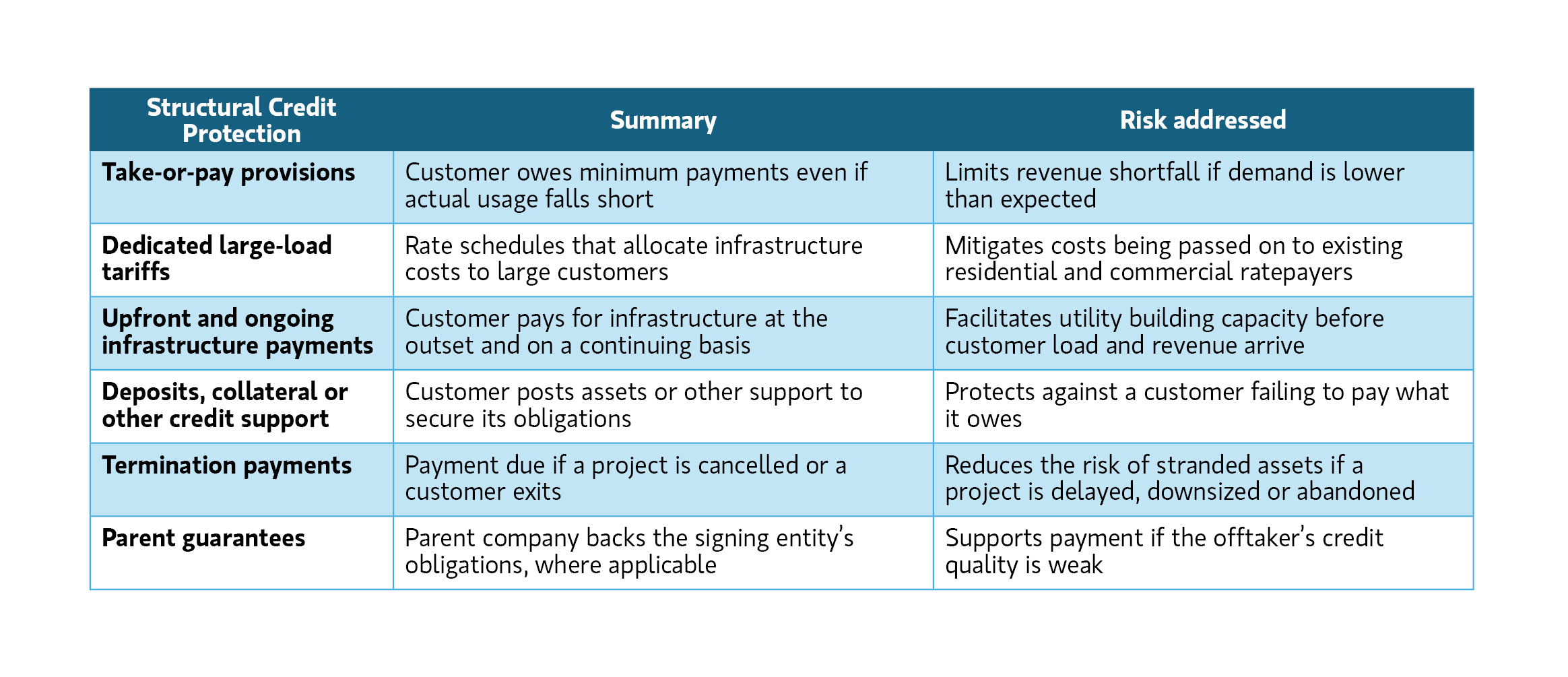
As a reminder, these structural credit protections do not protect investors against the risk of loss.
Key Structural Credit Protections
Structural credit protections vary by transaction, but commonly include:
Utilities and regulators are increasingly incorporating protections into the contracts and tariffs that govern AI-linked energy infrastructure. Virginia offers an example. In 2025, the state created a separate rate class for large customers, mainly data centers served by an investor-owned utility. The rules are meant to insulate residential and commercial customers from rate increases linked to onboarding large clients.
Under the rules, qualifying data center customers must commit to a contract term of at least 14 years and pay a minimum of 85% of contracted transmission and distribution costs, regardless of actual usage. Customers, without sufficient credit, may also have to provide collateral covering up to 60% of the minimum contract charges. Terms like these reduce the risk that a utility and consumers are left footing the bill for a stranded asset if a power project is delayed, downsized or abandoned.
Currently, investor-owned utilities operate under stricter and more standardized requirements than municipally owned systems. For instance, state regulators publicly review and approve rate classes and contract terms for large customers served by investor-owned utilities. By contrast, local boards set the terms at municipal utilities, with fewer disclosure requirements. While public power systems generally benefit from this localized control over rate setting and capital planning, this approach means requirements on large-load customers remain discretionary and less transparent. That makes credit risk harder to evaluate.
That said, discretion does not mean the absence of requirements, and the largest systems often require terms that match the regulated standard set for investor-owned utilities. For example, a large public power and water utility in Arizona, requires large-load customers to sign 15-year contracts, pay demand charges on the greater of actual use or 80% of forecasted demand, cover transmission costs, provide monthly load forecasts across the full term and post collateral.
Meanwhile, other issuers have more opaque terms. A small Minnesota utility, sold new bonds to investors, forecasting that its contracted revenue would grow from $3.5 million in 2025 to $32.4 million in 2028. Citing state data privacy law, the offering document does not identify the customers and the revenue that underpins the forecast or the terms of their agreements. This makes it difficult to evaluate the contract length, minimum-take provisions, collateral and the offtaker’s creditworthiness.
Structural credit: IOU vs. MOU requirements for large-load customers
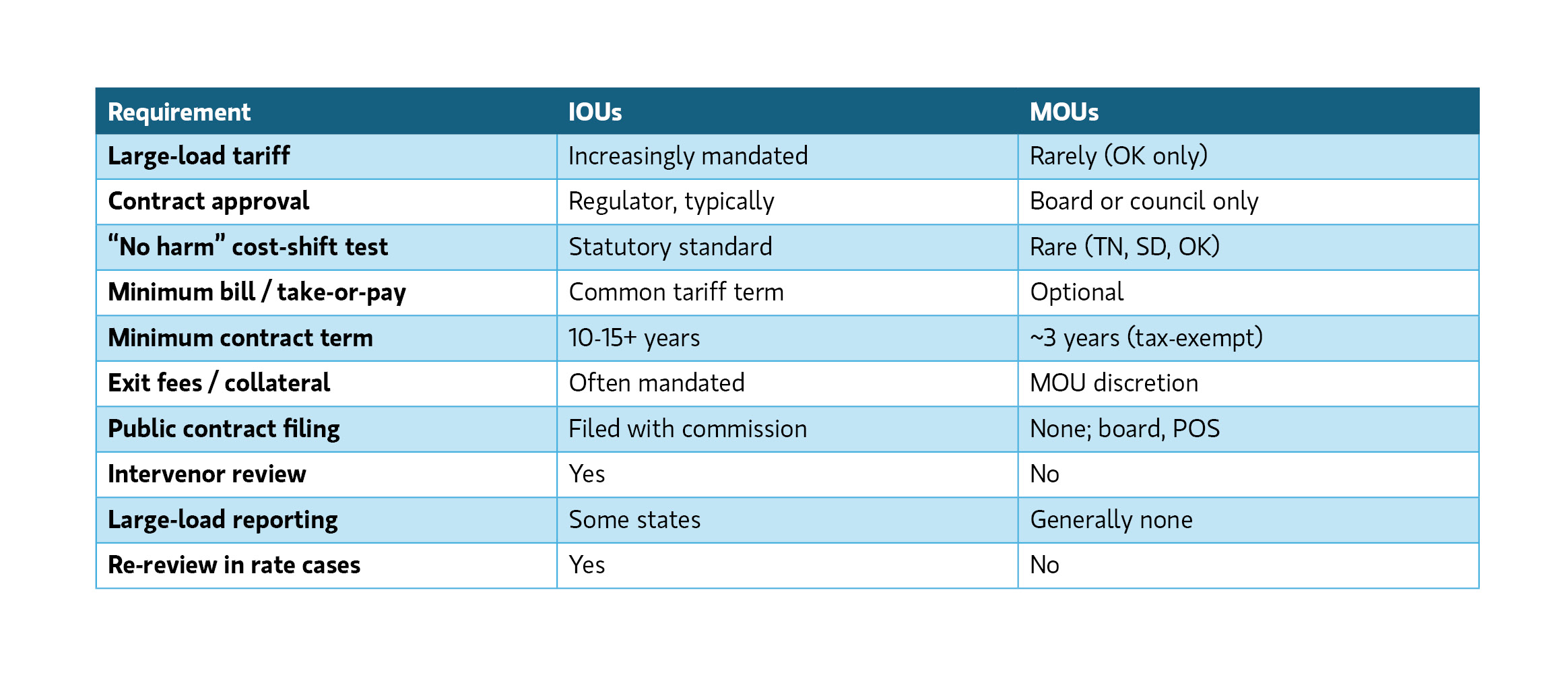
Structural credit: IOU vs. MOU requirements for large-load customers
A large public power system has the legal resources and the necessary board sophistication to negotiate and enforce complex terms. Meanwhile small public systems often lack that capacity and disclose far less. For that reason, we are selective and evaluate each credit on its own merits rather than against a sector standard.
A more restrictive political environment
Following the midterm elections, which shifted the political balance in Washington and in several states, scrutiny may increase around data center sitings, permitting, tax incentives and who pays for AI-linked energy infrastructure. Projects already underway and most capital plans for 2027 are less likely to be affected. However, the larger impact may emerge in 2028 and beyond, as new projects face potentially longer approval processes, tighter permitting standards and stronger cost-allocation requirements.
Moreover, how local communities stand to benefit from the AI-linked infrastructure expansion is becoming a bigger part of the equation for state governments and other stakeholders. A proposed data center and energy complex called the PORTS-Pike Technology Campus could create approximately 2,500 permanent jobs for residents around Piketon, Ohio. Because the site is partly federally owned, a payment in lieu of taxes arrangement has been discussed to generate local revenue. The project illustrates how communities can capture economic benefit from the construction of energy assets, even when the municipal market is not the source of infrastructure funding.
Slower development can be beneficial
While a slower project development pipeline may reduce anticipated load growth, utility revenues and potential property-tax benefits for local communities and issuers, it may still prove beneficial because it can lessen capital requirements, rate pressures on customers and the risk of utilities building ahead of demand.
Over the longer term, tighter cost-allocation requirements could be credit positive if they produce stronger contracts that require developers to pay for the capacity they need. The same logic extends beyond municipal issuers. Regulated investor-owned utilities also fund data center-related buildouts with debt. For them, moderating development could trim some anticipated earnings growth but would ease balance-sheet pressure by reducing the incremental capital they need to finance projects.
What matters for municipal investors
Data center investment could create meaningful opportunities for investors in the municipal market, but our credit assessment will depend on how each transaction is structured and who bears the risk. Our credit team examines what the bond proceeds finance, who is contractually responsible for payment and what economic benefits accrue to the community. We look for enforceable customer commitments and issuers with financial capacity to withstand delays or lower-than-expected demand. As this market develops, we will continue to assess whether those protections adequately support the credit quality of the bonds we hold for clients.
Featured Insights



RISK CONSIDERATIONS: The value of investments held by a Strategy may increase or decrease in response to economic, and financial events (whether real, expected or perceived) in the U.S. and global markets. There generally is limited public information about municipal issuers. As interest rates rise, the value of certain income investments is likely to decline. Investments in debt instruments may be affected by changes in the creditworthiness of the issuer and are subject to the risk of non-payment of principal and interest. The value of income securities also may decline because of real or perceived concerns about the issuer’s ability to make principal and interest payments. Income from tax-exempt municipal obligations could be declared taxable because of changes in tax laws, adverse interpretations by the relevant taxing authority or the non-compliant conduct of the issuer of an obligation. A portion of the Municipal Strategy’s distributions generally will be subject to the federal alternative minimum tax. The strategy may not be suitable for investors subject to the federal alternative.
Investing in companies in anticipation of a catalyst event, such as AI adoption, carries the risk that such catalysts may not occur, may be delayed, or that the market may react differently than expected. Companies focused on AI may have limited product lines, markets or financial resources, and their management and performance may be particularly impacted by events that adversely affect AI adoption, such as rapid changes in product technology cycles, product obsolescence, government regulation, cybersecurity concerns and competition.
IMPORTANT INFORMATION
A separately managed account may not be appropriate for all investors. Separate accounts managed according to the Strategy include a number of securities and will not necessarily track the performance of any index. Please consider the investment objectives, risks and fees of the Strategy carefully before investing. A minimum asset level is required. For important information about the investment managers, please refer to Form ADV Part 2.
The views and opinions expressed and/or analysis are those of the investment team as of the date of preparation of this material and are subject to change at any time without notice due to market or economic conditions and may not necessarily come to pass. Furthermore, the views will not be updated or otherwise revised to reflect information that subsequently becomes available or circumstances existing, or changes occurring, after the date of publication. The views expressed do not reflect the opinions of all investment personnel at Morgan Stanley Investment Management (MSIM) and its subsidiaries and affiliates (collectively “the Firm”) and may not be reflected in all the strategies and products that the Firm offers.
This material is a general communication, which is not impartial and all information provided has been prepared solely for informational and educational purposes and does not constitute an offer or a recommendation to buy or sell any particular security or to adopt any specific investment strategy. The information herein has not been based on a consideration of any individual investor circumstances and is not investment advice, nor should it be construed in any way as tax, accounting, legal or regulatory advice. To that end, investors should seek independent legal and financial advice, including advice as to tax consequences, before making any investment decision.
This material has been prepared on the basis of publicly available information, internally developed data and other third-party sources believed to be reliable. However, no assurances are provided regarding the reliability of such information and the Firm has not sought to independently verify information taken from public and third-party sources.
This material is not a product of Morgan Stanley’s Research Department and should not be regarded as a research material or a recommendation.
The Firm has not authorised financial intermediaries to use and to distribute this material, unless such use and distribution is made in accordance with applicable law and regulation. Additionally, financial intermediaries are required to satisfy themselves that the information in this material is appropriate for any person to whom they provide this material in view of that person’s circumstances and purpose. The Firm shall not be liable for, and accepts no liability for, the use or misuse of this material by any such financial intermediary.
This material may be translated into other languages. Where such a translation is made this English version remains definitive. If there are any discrepancies between the English version and any version of this material in another language, the English version shall prevail.
DISTRIBUTION
This material is only intended for and will only be distributed to persons resident in jurisdictions where such distribution or availability would not be contrary to local laws or regulations.
MSIM, the asset management division of Morgan Stanley (NYSE: MS), and its affiliates have arrangements in place to market each other’s products and services. Each MSIM affiliate is regulated as appropriate in the jurisdiction it operates. MSIM’s affiliates are: Calvert Research and Management, Eaton Vance Management, Parametric Portfolio Associates LLC, Parametric SAS, and Atlanta Capital Management LLC.
This material has been issued by any one or more of the following entities:
EMEA:
This material is for Professional Clients/Accredited Investors only. In the EU, MSIM materials are issued by MSIM Fund Management (Ireland) Limited (“FMIL”). FMIL is regulated by the Central Bank of Ireland and is incorporated in Ireland as a private company limited by shares with company registration number 616661 and has its registered address at 24-26 City Quay, Dublin 2, DO2 NY19, Ireland.
Outside the EU, MSIM materials are issued by Morgan Stanley Investment Management Limited (MSIM Ltd) is authorised and regulated by the Financial Conduct Authority. Registered in England. Registered No. 1981121. Registered Office: 25 Cabot Square, Canary Wharf, London E14 4QA.
In Switzerland, MSIM materials are issued by Morgan Stanley & Co. International plc, London (Zurich Branch) Authorised and regulated by the Eidgenössische Finanzmarktaufsicht ("FINMA"). Registered Office: Beethovenstrasse 33, 8002 Zurich, Switzerland.
Italy: MSIM FMIL (Milan Branch), (Sede Secondaria di Milano) Palazzo Serbelloni Corso Venezia, 16 20121 Milano, Italy. The Netherlands: MSIM FMIL (Amsterdam Branch), Rembrandt Tower, 11th Floor Amstelplein 1 1096HA, Netherlands. France: MSIM FMIL (Paris Branch), 61 rue de Monceau 75008 Paris, France. Spain: MSIM FMIL (Madrid Branch), Calle Serrano 55, 28006, Madrid, Spain. Germany: Germany: MSIM FMIL (Frankfurt Branch), Grosse Gallusstrasse 18, 60312 Frankfurt am Main, Germany (Gattung: Zweigniederlassung (FDI) gem. § 53b KWG). Denmark: MSIM FMIL (Copenhagen Branch), Gorrissen Federspiel, Axel Towers, Axeltorv2, 1609 Copenhagen V, Denmark.
MIDDLE EAST
Dubai International Financial Centre: This information does not constitute or form part of any offer to issue or sell any investment products in the UAE (including the Dubai International Financial Centre and the Abu Dhabi Global Market) and accordingly should not be construed as such. The content of this report has not been approved by or filed with the UAE Central Bank, the Dubai Financial Services Authority, the UAE Securities and Commodities Authority or the Financial Services Regulatory Authority.
Abu Dhabi Global Market ("ADGM"): This material is sent strictly within the context of, and constitutes, an Exempt Communication. This material relates to (strategy) which is not subject to any form of regulation or approval by the Financial Services Regulatory Authority of the Abu Dhabi Global Market (the “FSRA”).
Saudi Arabia
This financial promotion was issued and approved for use in Saudi Arabia by Morgan Stanley Saudi Arabia, Al Rashid Tower, Kings Sand Street, Riyadh, Saudi Arabia, authorized and regulated by the Capital Market Authority license number 06044-37.
US
NOT INSURED | OFFER NO BANK GUARANTEE | MAY LOSE VALUE | NOT INSURED BY ANY FEDERAL GOVERNMENT AGENCY | NOT A DEPOSIT
Latin America (Brazil, Chile Colombia, Mexico, Peru, and Uruguay) This material is for use with an institutional investor or a qualified investor only. All information contained herein is confidential and is for the exclusive use and review of the intended addressee and may not be passed on to any third party. This material is provided for informational purposes only and does not constitute a public offering, solicitation, or recommendation to buy or sell for any product, service, security and/or strategy. A decision to invest should only be made after reading the strategy documentation and conducting in-depth and independent due diligence.
ASIA PACIFIC
Hong Kong: This document has been issued by Morgan Stanley Asia Limited, CE No. AAD291, for use in Hong Kong and shall only be made available to “professional investors” as defined under the Securities and Futures Ordinance of Hong Kong (Cap 571). The contents of this document have not been reviewed nor approved by any regulatory authority including the Securities and Futures Commission in Hong Kong. Accordingly, save where an exemption is available under the relevant law, this document shall not be issued, circulated, distributed, directed at, or made available to, the public in Hong Kong.
Singapore: This material is disseminated in Singapore by Morgan Stanley Investment Management Company, Registration No. 199002743C. This material should not be considered to be the subject of an invitation for subscription or purchase, whether directly or indirectly, to the public or any member of the public in Singapore other than (i) to an institutional investor under section 304 of the Securities and Futures Act, Chapter 289 of Singapore (“SFA”), (ii) to a “relevant person” (which includes an accredited investor) pursuant to section 305 of the SFA, and such distribution is in accordance with the conditions specified in section 305 of the SFA; or (iii) otherwise pursuant to, and in accordance with the conditions of, any other applicable provision of the SFA. This material has not been reviewed by the Monetary Authority of Singapore.
Australia: This material is provided by Morgan Stanley Investment Management (Australia) Pty Ltd ABN 22122040037, AFSL No. 314182 and its affiliates and does not constitute an offer of interests. Morgan Stanley Investment Management (Australia) Pty Limited arranges for MSIM affiliates to provide financial services to Australian wholesale clients. This material will not be lodged with the Australian Securities and Investments Commission.
Japan: For professional investors, this material is circulated or distributed solely for informational purposes. For non-professional investors, this material is provided in connection with Morgan Stanley Investment Management (Japan) Co., Ltd. (“MSIMJ”)’s business with respect to discretionary investment management agreements (“IMA”) and investment advisory agreements (“IAA”). This does not constitute a recommendation or solicitation of transactions nor offers any particular financial instruments. Under an IMA, with respect to the management of client assets, the client prescribes basic management policies in advance and commissions MSIMJ to make all investment decisions based on an analysis of the value, etc. of the securities, and MSIMJ accepts such commission. The client shall delegate to MSIMJ the authorities necessary to make such investment decisions. MSIMJ exercises these delegated authorities accordingly, and the client shall not make individual instructions. All investment profits and losses belong to the clients; principal is not guaranteed. Please consider the investment objectives and nature of risks before investing. As an investment advisory fee for an IAA or an IMA, the amount of assets subject to the contract multiplied by a certain rate (the upper limit is 2.20% per annum (including tax)) shall be incurred in proportion to the contract period. For some strategies, a contingency fee may be incurred in addition to the fee mentioned above. Indirect charges also may be incurred, such as brokerage commissions for underlying securities. Since these charges and expenses vary by contract and other factors, MSIMJ cannot present the rates, upper limits, etc. in advance. All clients should read thoroughly the Documents Provided Prior to the Conclusion of a Contract carefully before executing an agreement. This material is distributed in Japan by MSIMJ, Registered No. 410 (Director of Kanto Regional Finance Bureau (Financial Instruments Firms)), Membership: the Japan Securities Dealers Association, the Investment Management Association of Japan and the Type II Financial Instruments Firms Association.


 This image indicates content designed specifically for Financial Advisors / Investment Professionals. This material is not to be used with the public.
