



Scroll Up Top
Print icon
Print

In recent months, concerns have intensified that the rapid growth in artificial intelligence (AI) investment is becoming a “bubble.” This has coincided with a flurry of massive deals among the largest U.S. technology companies. The proliferation and potential implications of these deals for investors prompted the Eaton Vance (EV) equity department to conduct a “Bull vs. Bear” debate over AI funding.

The collaborative discussion, with representation from all EV equity teams, exposed both the scale of ambition driving the AI revolution and the structural risks that could constrain it. Below, we summarize the two competing narratives that emerged.

The Bull Case: A Self-Funding Productivity Supercycle
The bullish view holds that AI build-out represents the next great wave of global industrial investment—comparable to postwar manufacturing or the1990s internet revolution. Its deployment across health care, education, logistics and financial services could potentially unlock immense productivity gains.

1. Scale justifies the spend

Global corporate profits of about $5 trillion in 2025, as reported by Forbes, imply enormous reinvestment capacity.1 A mere 1% to 2% uplift in profit margins resulting from AI productivity gains could generate $1 trillion in incremental earnings—enough to justify a $10 trillion AI investment base. Proponents argue that even a small allocation, say 1% of global financial assets, could mobilize $3 trillion toward AI infrastructure without dislocating capital markets.

2. Financing capacity exists
Hyperscalers2 remain at the center of this thesis. With potential capital expenditures of $4 trillion through 2030, an additional $1.2 trillion in free cash flow, and as much as $2.3 trillion in balance-sheet leverage, the combined funding power of the six dominant cloud players could exceed $7.5 trillion.3 Other potential sources of funding include sovereign wealth funds and debt markets via asset-backed securities. In October, Meta raised $27 billion in debt, structured at a 6.6% fixed rate, illustrating the maturation of AI infrastructure financing into a relatively low-risk, quasi-utility asset class.

3. Circularity creates self-sustaining growth
While concerns have grown about the circularity of AI funding, as illustrated in Display 1,  the bullish view sees it as a strength: industry leaders reinvesting profits into their ecosystems has historically driven industrial maturity. Automotive and aerospace giants once financed suppliers, built leasing arms, and took equity stakes in strategic vendors. Applied to AI, this approach could mean NVIDIA or Microsoft taking small stakes in chip foundries, data center operators or model providers—seeding the next generation of capacity while strengthening supply chain stability.

AI Funding Relationships
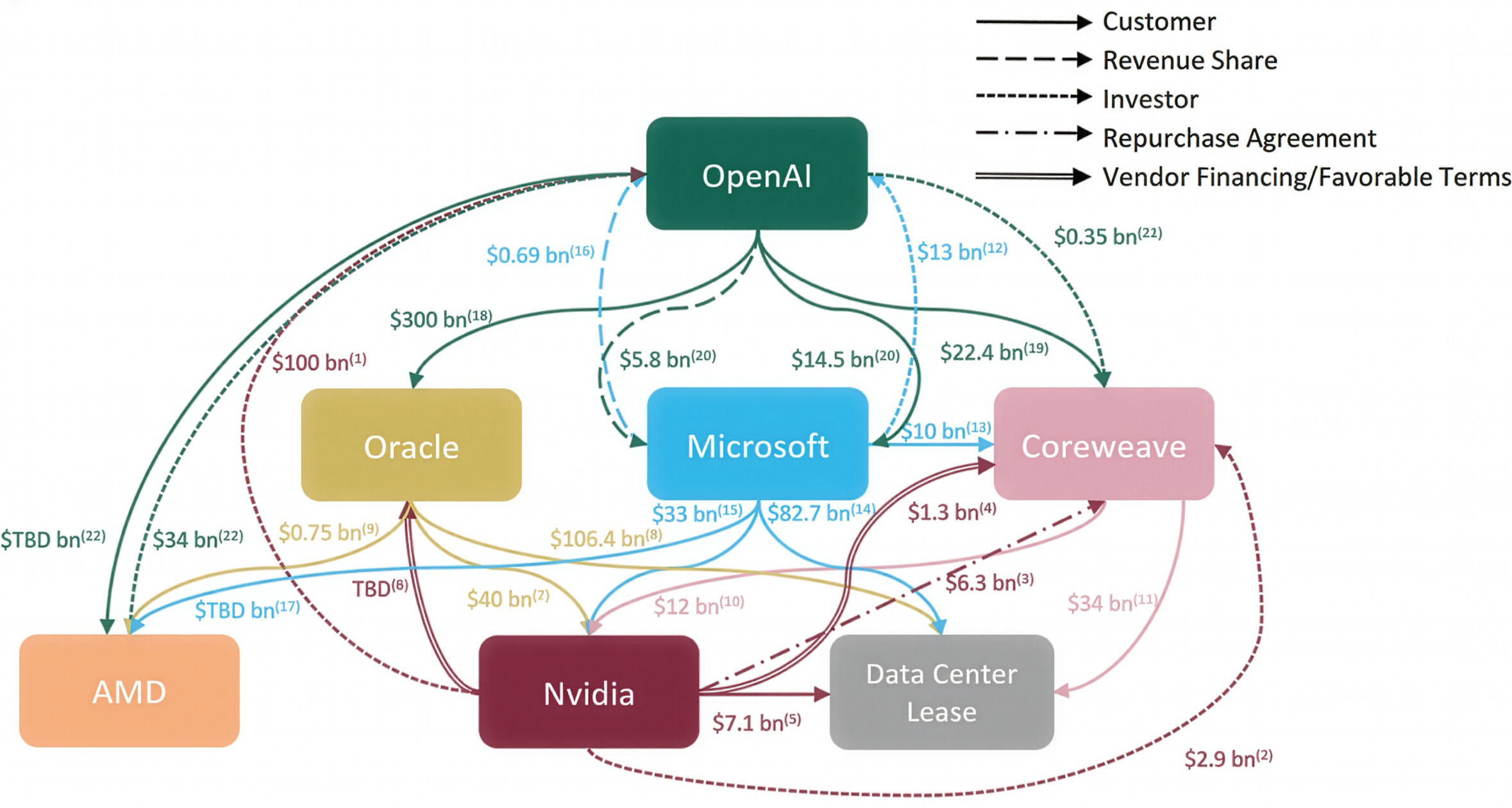
Display 1
insight_bull-and-bear-investment-cases_display1.png

Source: Morgan Stanley Research, “AI: Mapping Circularity,” October 8, 2025.

4. Technological and efficiency tailwinds
Finally, the bulls argue that concerns over power shortages and hardware obsolescence will be mitigated by efficiency gains. NVIDIA reports a 40,000% improvement in their chips’ energy efficiency over time, suggesting that compute density and performance per watt will continue to outpace demand growth. Meanwhile, rapid improvements in model performance may create deflationary effects, allowing AI to boost productivity across the global economy faster than it consumes capital or energy. In this view, AI spending becomes self-reinforcing: productivity gains fund further investment, drawing more capital into the ecosystem—a classic virtuous cycle.

The Bear Case: Unsustainable Leverage, Thin Revenues and Physical Limits
The bear case challenges the notion that AI’s financing machine can run indefinitely without seeing sufficient revenues to justify the investment. This view suggests that beneath the headline numbers, the business models supporting the sector remain fragile, while physical and regulatory bottlenecks loom large.

1. Fragile revenue foundations
OpenAI’s monetization dilemma is a central concern. Despite its vast user base, only a small fraction of users pay directly, leaving revenue concentrated in subscriptions and application programming interface (API) fees. While some may assume adoption by businesses will close this gap, the path to sustained free cash flow is quite uncertain. With projections suggesting OpenAI may seek $1.6 trillion in new capital, skeptics question whether such ambitions can coexist with a largely free consumer model resulting in revenues of just $13 billion per year. The risk is that a prolonged mismatch between spending and revenue could erode balance sheets, triggering refinancing stress and equity underperformance.

2. Leverage masks fragility
Heavy reliance on debt markets—especially structured finance—could obscure true risk concentration. The Meta financing deal, cited by bulls as a model of efficiency, could come to resemble the over-leveraged telecom infrastructure of the early 2000s. If rates rise or utilization lags, the yield advantage could quickly reverse, pressuring balance sheets across the ecosystem.

3. Power as the hard constraint
Perhaps the most tangible risk lies in power infrastructure. Between 2028 and 2035, data centers could add a projected 15% to 20% strain on global grids. Even with efficiency gains, power transmission, transformer production and permitting timelines create bottlenecks that financial engineering cannot solve. The result could be stranded capital: data centers built faster than utilities can deliver power.

4. Governance and concentration risks
Finally, investors need to consider governance. The market’s overreliance on visionary figures—OpenAI CEO Sam Altman foremost among them—creates fragility in leadership and strategy. Meanwhile, the distinction between “defensive” spending to protect existing platforms—such as Google adding Gemini to protect its search business—and “offensive” expansion, like Microsoft introducing and charging more for Co-Pilot, remains blurred. This raises concerns that much of today’s capital expenditures serve short-term competitive positioning rather than long-term profitability.

Implications for Investors
Much of the U.S. equity market’s gains since ChatGPT’s launch in late 2022 have been driven by companies at the center of the AI ecosystem. As investors look to the future, a key question is whether this powerful trend can continue or is vulnerable to a sharp pullback. One of the key challenges is in identifying which companies can convert AI infrastructure into recurring, high-margin revenue streams, and which are merely relying on increasingly risky financing.

AI may indeed catalyze the next productivity supercycle. But as this debate made clear, the path from vision to value will depend less on the amount of capital that is raised—and more on how productively that capital is deployed.


1 Forbes Releases 23rd Annual Global 2000 Ranking Of The World’s Largest Companies, June 12, 2025.

2This refers to global cloud and platform companies driving most of the industry’s capital expenditure, including Microsoft, Amazon, Alphabet (Google), Meta, Apple, Oracle, and OpenAI.

3 Source: Eaton Vance, Bloomberg, ChatGPT.

The Authors

Risk Considerations: 
There is no guarantee that any investment strategy will work under all market conditions, and each investor should evaluate their ability to invest for the long-term, especially during periods of downturn in the market.

A separately managed account may not be appropriate for all investors. Separate accounts managed according to the particular strategy may include securities that may not necessarily track the performance of a particular index. Please consider the investment objectives, risks and fees of the Strategy carefully before investing. A minimum asset level is required. For important information about the investment managers, please refer to Form ADV Part 2.

The views and opinions and/or analysis expressed are those of the author or the investment team as of

the date of preparation of this material and are subject to change at any time without notice due to market or economic conditions and may not necessarily come to pass. Furthermore, the views will not be updated or otherwise revised to reflect information that subsequently becomes available or circumstances existing, or changes occurring, after the date of publication. The views expressed do not reflect the opinions of all investment personnel at Morgan Stanley Investment Management (MSIM) and its subsidiaries and affiliates (collectively “the Firm”) and may not be reflected in all the strategies and products that the Firm offers.

Forecasts and/or estimates provided herein are subject to change and may not actually come to pass. Information regarding expected market returns and market outlooks is based on the research, analysis and opinions of the authors or the investment team. These conclusions are speculative in nature, may not come to pass and are not intended to predict the future performance of any specific strategy or product the Firm offers. Future results may differ significantly depending on factors such as changes in securities or financial markets or general economic conditions.

This material has been prepared on the basis of publicly available information, internally developed data and other third-party sources believed to be reliable. However, no assurances are provided regarding the reliability of such information and the Firm has not sought to independently verify information taken from public and third-party sources.

This material is a general communication, which is not impartial, and all information provided has been prepared solely for informational and educational purposes and does not constitute an offer or a recommendation to buy or sell any particular security or to adopt any specific investment strategy. The information herein has not been based on a consideration of any individual investor circumstances and is not investment advice, nor should it be construed in any way as tax, accounting, legal or regulatory advice. To that end, investors should seek independent legal and financial advice, including advice as to tax consequences, before making any investment decision.

Charts and graphs provided herein are for illustrative purposes only. Past performance is no guarantee of future results.

The indexes are unmanaged and do not include any expenses, fees or sales charges. It is not possible to invest directly in an index. Any index referred to herein is the intellectual property (including registered trademarks) of the applicable licensor. Any product based on an index is in no way sponsored, endorsed, sold or promoted by the applicable licensor and it shall not have any liability with respect thereto.

This material is not a product of Morgan Stanley’s Research Department and should not be regarded as a research material or a recommendation.

The Firm has not authorized financial intermediaries to use and to distribute this material, unless such use and distribution is made in accordance with applicable law and regulation. Additionally, financial intermediaries are required to satisfy themselves that the information in this material is appropriate for any person to whom they provide this material in view of that person’s circumstances and purpose. The Firm shall not be liable for, and accepts no liability for, the use or misuse of this material by any such financial intermediary.

This material may be translated into other languages. Where such a translation is made this English version remains definitive. If there are any discrepancies between the English version and any version of this material in another language, the English version shall prevail.

The whole or any part of this material may not be directly or indirectly reproduced, copied, modified, used to create a derivative work, performed, displayed, published, posted, licensed, framed, distributed or transmitted or any of its contents disclosed to third parties without the Firm’s express written consent. This material may not be linked to unless such hyperlink is for personal and non-commercial use. All information contained herein is proprietary and is protected under copyright and other applicable law.

Eaton Vance, Atlanta Capital, Parametric and Calvert are part of Morgan Stanley Investment Management.  Morgan Stanley Investment Management is the asset management division of Morgan Stanley.

DISTRIBUTION
This material is only intended for and will only be distributed to persons resident in jurisdictions where such distribution or availability would not be contrary to local laws or regulations.

MSIM, the asset management division of Morgan Stanley (NYSE: MS), and its affiliates have arrangements in place to market each other’s products and services.  Each MSIM affiliate is regulated as appropriate in the jurisdiction it operates. MSIM’s affiliates are: Eaton Vance Management (International) Limited, Eaton Vance Advisers International Ltd, Calvert Research and Management, Eaton Vance Management, Parametric Portfolio Associates LLC, and Atlanta Capital Management LLC.

This material has been issued by any one or more of the following entities:

EMEA
This material is for Professional Clients/Accredited Investors only.

In the EU, MSIM and Eaton Vance materials are issued by MSIM Fund Management (Ireland) Limited (“FMIL”). FMIL is regulated by the Central Bank of Ireland and is incorporated in Ireland as a private company limited by shares with company registration number 616661 and has its registered address at 24-26 City Quay, Dublin 2 , DO2 NY19, Ireland.

Outside the EU, MSIM materials are issued by Morgan Stanley Investment Management Limited (MSIM Ltd) is authorised and regulated by the Financial Conduct Authority. Registered in England. Registered No. 1981121. Registered Office: 25 Cabot Square, Canary Wharf, London E14 4QA.

In Switzerland, MSIM materials are issued by Morgan Stanley & Co. International plc, London (Zurich Branch) Authorised and regulated by the Eidgenössische Finanzmarktaufsicht ("FINMA"). Registered Office: Beethovenstrasse 33, 8002 Zurich, Switzerland.

Outside the US and EU, Eaton Vance materials are issued by Eaton Vance Management (International) Limited (“EVMI”) 125 Old Broad Street, London, EC2N 1AR, UK, which is authorised and regulated in the United Kingdom by the Financial Conduct Authority. 

Italy: MSIM FMIL (Milan Branch), (Sede Secondaria di Milano) Palazzo Serbelloni Corso Venezia, 16 20121 Milano, Italy. The Netherlands: MSIM FMIL (Amsterdam Branch), Rembrandt Tower, 11th Floor Amstelplein 1 1096HA, Netherlands. France: MSIM FMIL (Paris Branch), 61 rue de Monceau 75008 Paris, France. Spain: MSIM FMIL (Madrid Branch), Calle Serrano 55, 28006, Madrid, Spain. Germany: MSIM FMIL Frankfurt Branch, Große Gallusstraße 18, 60312 Frankfurt am Main, Germany (Gattung: Zweigniederlassung (FDI) gem. § 53b KWG). Denmark: MSIM FMIL (Copenhagen Branch), Gorrissen Federspiel, Axel Towers, Axeltorv2, 1609 Copenhagen V, Denmark.

MIDDLE EAST
Dubai:
MSIM Ltd (Representative Office, Unit Precinct 3-7th Floor-Unit 701 and 702, Level 7, Gate Precinct Building 3, Dubai International Financial Centre, Dubai, 506501, United Arab Emirates. Telephone: +97 (0)14 709 7158).

This document is distributed in the Dubai International Financial Centre by Morgan Stanley Investment Management Limited (Representative Office), an entity regulated by the Dubai Financial Services Authority (“DFSA”). It is intended for use by professional clients and market counterparties only. This document is not intended for distribution to retail clients, and retail clients should not act upon the information contained in this document.

This document relates to a financial product which is not subject to any form of regulation or approval by the DFSA. The DFSA has no responsibility for reviewing or verifying any documents in connection with this financial product. Accordingly, the DFSA has not approved this document or any other associated documents nor taken any steps to verify the information set out in this document, and has no responsibility for it. The financial product to which this document relates may be illiquid and/or subject to restrictions on its resale or transfer. Prospective purchasers should conduct their own due diligence on the financial product. If you do not understand the contents of this document, you should consult an authorised financial adviser.

U.S.
NOT FDIC INSURED | OFFER NO BANK GUARANTEE | MAY LOSE VALUE | NOT INSURED BY ANY FEDERAL GOVERNMENT AGENCY | NOT A DEPOSIT

Latin America (Brazil, Chile Colombia, Mexico, Peru, and Uruguay)

This material is for use with an institutional investor or a qualified investor only. All information contained herein is confidential and is for the exclusive use and review of the intended addressee, and may not be passed on to any third party. This material is provided for informational purposes only and does not constitute a public offering, solicitation or recommendation to buy or sell for any product, service, security and/or strategy. A decision to invest should only be made after reading the strategy documentation and conducting in-depth and independent due diligence.

ASIA PACIFIC
Hong Kong:
This material is disseminated by Morgan Stanley Asia Limited for use in Hong Kong and shall only be made available to “professional investors” as defined under the Securities and Futures Ordinance of Hong Kong (Cap 571). The contents of this material have not been reviewed nor approved by any regulatory authority including the Securities and Futures Commission in Hong Kong. Accordingly, save where an exemption is available under the relevant law, this material shall not be issued, circulated, distributed, directed at, or made available to, the public in Hong Kong. Singapore: This material is disseminated by Morgan Stanley Investment Management Company and should not be considered to be the subject of an invitation for subscription or purchase, whether directly or indirectly, to the public or any member of the public in Singapore other than (i) to an institutional investor under section 304 of the Securities and Futures Act, Chapter 289 of Singapore (“SFA”); (ii) to a “relevant person” (which includes an accredited investor) pursuant to section 305 of the SFA, and such distribution is in accordance with the conditions specified in section 305 of the SFA; or (iii) otherwise pursuant to, and in accordance with the conditions of, any other applicable provision of the SFA. This publication has not been reviewed by the Monetary Authority of Singapore.   Australia: This material is provided by Morgan Stanley Investment Management (Australia) Pty Ltd ABN 22122040037, AFSL No. 314182 and its affiliates and does not constitute an offer of interests. Morgan Stanley Investment Management (Australia) Pty Limited arranges for MSIM affiliates to provide financial services to Australian wholesale clients. Interests will only be offered in circumstances under which no disclosure is required under the Corporations Act 2001 (Cth) (the “Corporations Act”). Any offer of interests will not purport to be an offer of interests in circumstances under which disclosure is required under the Corporations Act and will only be made to persons who qualify as a “wholesale client” (as defined in the Corporations Act). This material will not be lodged with the Australian Securities and Investments Commission.

Japan
For professional investors, this material is circulated or distributed for informational purposes only. For those who are not professional investors, this material is provided in relation to Morgan Stanley Investment Management (Japan) Co., Ltd. (“MSIMJ”)’s business with respect to discretionary investment management agreements (“IMA”) and investment advisory agreements (“IAA”).This is not for the purpose of a recommendation or solicitation of transactions or offers any particular financial instruments. Under an IMA, with respect to management of assets of a client, the client prescribes basic management policies in advance and commissions MSIMJ to make all investment decisions based on an analysis of the value, etc. of the securities, and MSIMJ accepts such commission. The client shall delegate to MSIMJ the authorities necessary for making investment. MSIMJ exercises the delegated authorities based on investment decisions of MSIMJ, and the client shall not make individual instructions.  All investment profits and losses belong to the clients; principal is not guaranteed. Please consider the investment objectives and nature of risks before investing. As an investment advisory fee for an IAA or an IMA, the amount of assets subject to the contract multiplied by a certain rate (the upper limit is 2.20% per annum (including tax)) shall be incurred in proportion to the contract period. For some strategies, a contingency fee may be incurred in addition to the fee mentioned above. Indirect charges also may be incurred, such as brokerage commissions for incorporated securities. Since these charges and expenses are different depending on a contract and other factors, MSIMJ cannot present the rates, upper limits, etc. in advance. All clients should read the Documents Provided Prior to the Conclusion of a Contract carefully before executing an agreement. This material is disseminated in Japan by MSIMJ, Registered No. 410 (Director of Kanto Local Finance Bureau (Financial Instruments Firms)), Membership: the Japan Securities Dealers Association, The Investment Trusts Association, Japan, the Japan Investment Advisers Association and the Type II Financial Instruments Firms Association.